Preparing car park and surface water drainage for winter
Get your car park and surface water drainage inspected and cleaned between September and November, before leaf fall and silt choke it and the wettest, coldest months arrive. Clear gullies, channel drains and catch pits, check and empty interceptors, confirm soakaways and attenuation tanks are draining, and record everything. That reduces standing water, ice, flooding and pollution risk, and helps show you acted reasonably.
Why is autumn and winter the risk period?
Many winter drainage problems build up over autumn:
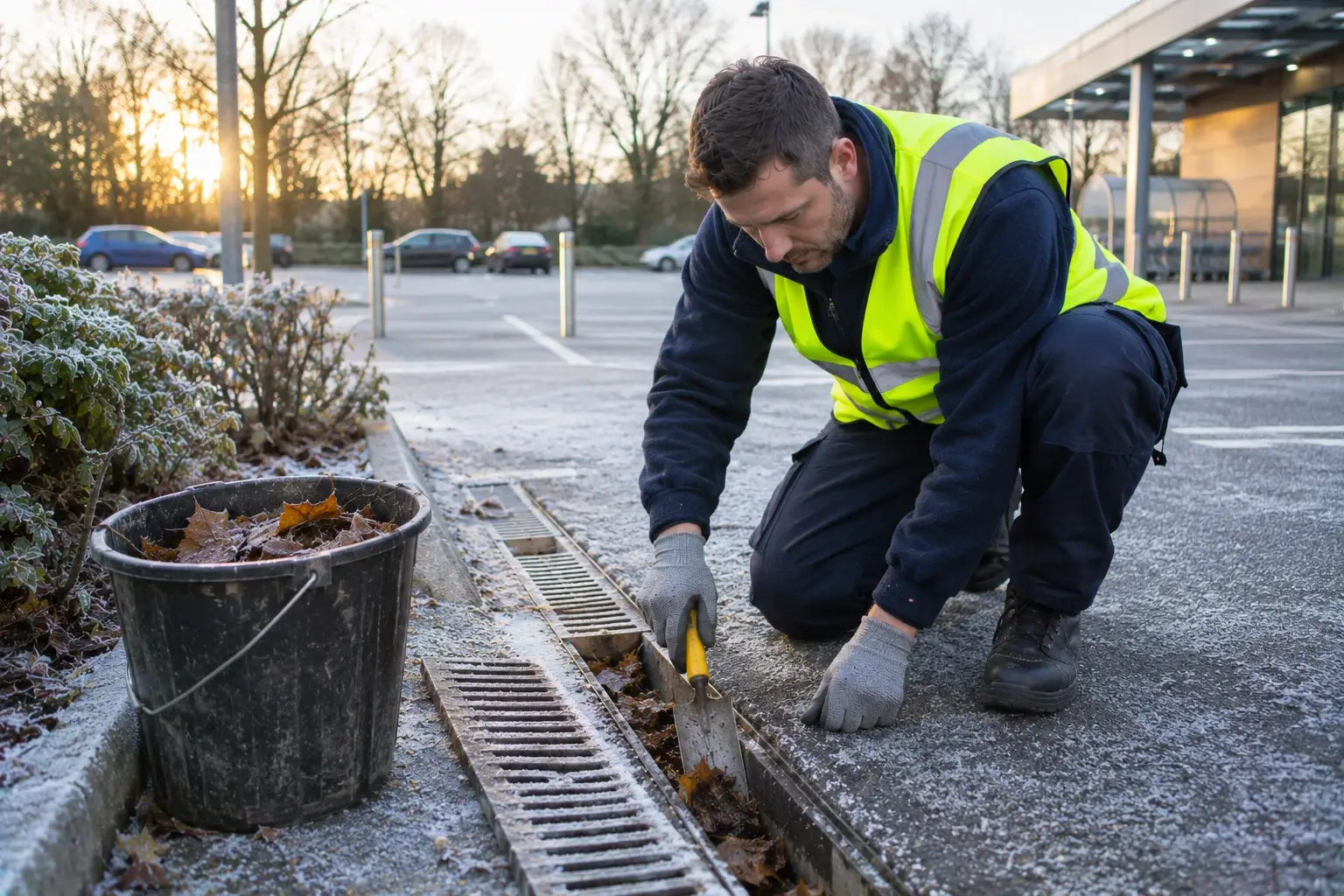
- Leaf fall. Leaves sit on grates and wash into gullies and channels, where they mat together and block outlets. Kent County Council advises residents to “clear away any fallen leaves blocking the drains” in autumn and winter.
- Silt and grit. Sediment from vehicles, landscaping and last winter’s gritting settles in gully pots, catch pits, interceptors and storage tanks, steadily reducing their capacity.
- Heavier rain. A partly blocked system may cope with light rain, then overflow in a downpour, leaving ponding across bays and walkways.
- Freeze-thaw. Water that cannot drain away freezes when temperatures drop, and repeated freeze-thaw cycles make icy patches a recurring problem.
The Health and Safety Executive (HSE) specifically lists car parks, pedestrian walkways, sloped areas and “areas constantly in the shade or wet” among the outdoor areas most likely to be affected by ice. A car park with poor drainage can turn rain into an ice hazard.
Which drainage assets need checking?
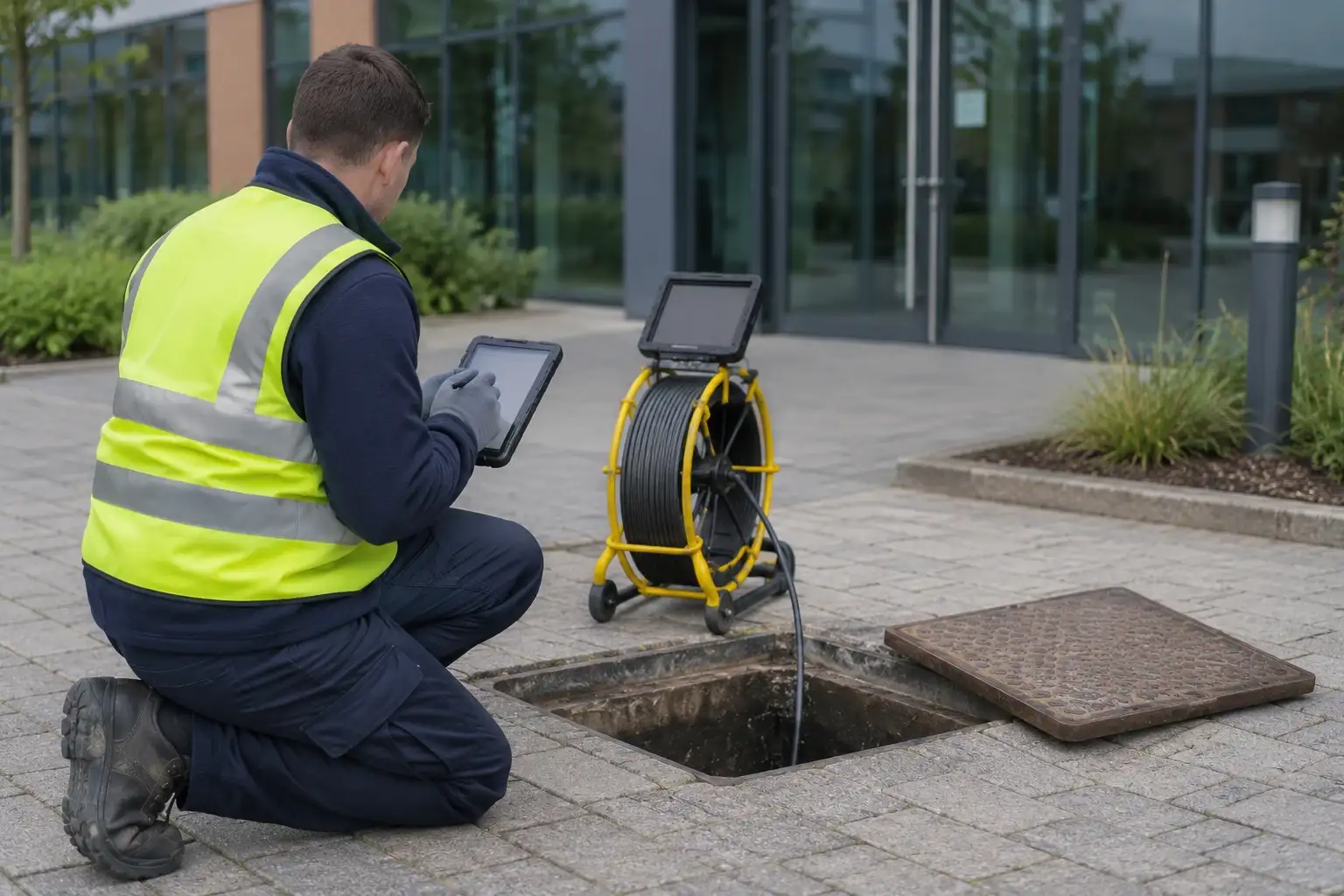
Most commercial car parks have a mix of the assets below. Your drainage drawings, O&M manual or a CCTV drain survey will tell you what you actually have and where it discharges.
| Asset | What it does | What goes wrong in winter |
|---|---|---|
| Road gullies | Collect run-off through a grate into a pot that traps silt | Grates covered by leaves; pots full of silt; outlets blocked |
| Linear / channel drains | Collect run-off along a line, often at entrances, ramps or bay edges | Channels and silt boxes fill with debris; grates loosen or break |
| Catch pits | Chambers that let silt settle before water moves on | Full of sediment, passing silt downstream |
| Oil separators (interceptors) | Hold back oil and silt before water leaves site | Oil or silt near capacity; alarms faulty; overdue service |
| Soakaways | Let water infiltrate into the ground | Silted up, so water drains slowly or backs up |
| Attenuation tanks / crates | Store storm water and release it slowly | Sediment and debris reduce storage; inlets blocked |
| Flow controls (e.g. vortex controls, orifice plates) | Limit the discharge rate from storage | Blocked by debris, causing backing up |
| Permeable paving | Lets water pass through the surface | Joints clogged with silt and organic matter |
| Swales and basins | Shallow planted channels and depressions that convey and store water | Litter, leaves and sediment; blocked inlets and outlets |
| Outfalls | Where the system discharges to a sewer, watercourse or ditch | Blocked or obstructed; damaged flap valves or grilles |
A blocked flow control or outfall can back up the whole system, even when the gullies look clean.
What should a pre-winter drainage checklist include?
Aim to complete this between September and November, with a second leaf clearance after peak leaf fall.
Gullies, channels and catch pits
- Clear grates and the area around them of leaves and debris.
- Empty gully pots, silt boxes and catch pits, commonly by vacuum tanker or jetting.
- Check grates, frames and covers are secure, level and undamaged.
- Jet-clean connecting pipes where water is slow to clear (jetting and blockage clearance).
Oil separators
- Check oil and silt levels and that alarms and warning devices work.
- Arrange emptying if levels are significant, and refill with clean water before putting the separator back into use.
- Confirm waste paperwork is in place (see below).
Soakaways, tanks and flow controls
- Lift covers and inspect chambers for silt and debris.
- Check water drains down in a reasonable time after rain.
- Clear and inspect flow controls, inlets and overflow routes.
SuDS features and outfalls
- Remove leaves, litter and sediment from permeable paving, swales and basins.
- Inspect outfalls for blockages and damage.
Surface and site
- Walk the site after heavy rain and note where water ponds.
- Identify spots that will need priority gritting.
- Check manhole covers are colour-coded correctly (see below).
Paperwork
- Update your asset register, maintenance log and photos.
- Agree emergency contacts and call-out arrangements before the first storm.
What are your legal duties?
This is a general overview, not legal advice. Who is responsible for what often depends on your lease or management agreement, so check it (our guide to commercial drain responsibility covers this in more detail).
Slips on standing water and ice
Under the Occupiers’ Liability Act 1957, an occupier owes visitors a “common duty of care”. The Act defines that as a duty “to take such care as in all the circumstances of the case is reasonable to see that the visitor will be reasonably safe” using the premises. It does not demand perfection, but a known ponding spot that freezes every winter and is never fixed may be hard to defend as reasonable.
For workplaces, the Workplace (Health, Safety and Welfare) Regulations 1992 also require floors to have “effective means of drainage where necessary”, and floors and traffic routes to be kept free, so far as is reasonably practicable, of substances that may cause people to slip, trip or fall.
The Occupiers’ Liability Act also says an occupier is not automatically answerable for a danger caused by an independent contractor’s faulty construction, maintenance or repair work, if they acted reasonably in giving the work to that contractor and took reasonable steps to satisfy themselves that the contractor was competent and the work had been properly done. That is a good reason to keep records of who did what, and when.
Pollution from car parks
GOV.UK guidance says that “surface water drains discharge directly to the environment”. It also warns that drainage systems “can very quickly transport pollutants off site and into the environment”, so oil, fuel or contaminated run-off entering them is a pollution risk.
According to the same guidance:
- You may need an oil separator for “car parks larger than 800m2 or for 50 or more parking spaces”, or for smaller car parks that discharge to a sensitive environment.
- British Standards recommend checking separators at least every six months for oil and silt build-up and that all parts are working.
- Separators supplied in England, Wales and Scotland have legally needed a warning device or high-level alarm since 1 January 2021.
- Separators should be emptied when significant oil or silt builds up, after a spill, or when the alarm goes off. The oil and sediment removed are hazardous waste: the waste removal company must have a waste carriers licence, and the waste must be moved under a hazardous waste consignment note.
- Manhole covers should be colour-coded: blue for surface water, red for foul, and a red “C” for combined systems. Any misconnections must be fixed.
A pre-winter check is a sensible time to do one of the two six-monthly inspections.
Flood risk
As Adur & Worthing Councils’ guidance puts it, drains on private land that serve only that property are the owner’s responsibility. The highways authority clears public road gullies, not yours. Blocked site drainage can flood your own building and send water onto neighbouring land and roads.
How does SuDS maintenance fit in?
Many newer sites were built with sustainable drainage systems (SuDS): permeable paving, swales, basins, and below-ground attenuation. These often come with a maintenance plan, which may be based on CIRIA’s The SuDS Manual (C753, 2015). The manual covers the planning, design, construction, operation and maintenance of SuDS and is free to download from CIRIA.
Treat the manual’s general maintenance guidance as a starting point: your site’s own SuDS maintenance plan, planning conditions or adoption agreement take priority, so find and follow them.
Silted permeable paving and blocked swale inlets stop SuDS working as designed, so include them in the autumn clearance.
How do drainage and gritting work together?
Gritting and drainage solve different parts of the same problem. HSE guidance says gritting should be done “when frost, ice or snow is forecast or when walkways are likely to be damp or wet and the floor temperatures are at, or below freezing”. It also notes that salt “doesn’t work instantly”, and that heavy rain can wash it away.
Good drainage leaves less water on the surface to freeze. In practice, share the ponding spots from your walk-round with whoever grits the site, fix ponding rather than relying on grit every night, and check gullies for washed-in grit after the thaw.
BAES offers winter gritting as part of its wider facilities services, so drainage and gritting can be planned together.
What records should you keep?
Records show you took reasonable care and make next year’s planning easier. Keep:
- an asset register and drainage plan showing each gully, channel, chamber, separator, tank, flow control and outfall
- dated maintenance logs and photos (before and after)
- separator inspection, emptying and alarm test records, plus waste transfer or consignment notes (GOV.UK says separators should have full service and maintenance records available for inspection)
- CCTV survey reports and defect lists (how to read a CCTV report)
- the SuDS maintenance plan and evidence it is being followed
- a log of incidents, such as flooding, ponding and slips, and what you did about them
A planned maintenance contract can build these visits and records into a fixed schedule, so the autumn check happens every year without anyone having to remember it.
Key takeaways
- Book drainage maintenance for September–November, with a follow-up after peak leaf fall.
- Check the whole system, gullies to outfall.
- Inspect oil separators at least every six months and keep the records.
- Follow your SuDS maintenance plan.
- Share ponding spots with your gritting provider.
Sources
- Occupiers’ Liability Act 1957, legislation.gov.uk: https://www.legislation.gov.uk/ukpga/Eliz2/5-6/31
- The Workplace (Health, Safety and Welfare) Regulations 1992, regulation 12, legislation.gov.uk: https://www.legislation.gov.uk/uksi/1992/3004/regulation/12
- Pollution prevention for businesses, GOV.UK: https://www.gov.uk/guidance/pollution-prevention-for-businesses
- Slips and trips: bad weather, HSE: https://www.hse.gov.uk/logistics/slips-trips-bad-weather.htm
- Slips and trips FAQs, HSE: https://www.hse.gov.uk/slips/faq.htm
- The SuDS Manual (C753), CIRIA: https://www.ciria.org/CIRIA/Books/Free_publications/C753F.aspx
- Highway drainage systems, Kent County Council: https://www.kent.gov.uk/roads-and-travel/what-we-look-after/highway-drainage-systems
- Blocked drains, sewers or gullies, Adur & Worthing Councils: https://www.adur-worthing.gov.uk/environmental-health/pollution/drains-and-sewers/
Questions
When is the best time to clean car park gullies?
Autumn, ideally between September and November, so gullies are clear before the wettest months. Leafy sites often need a second visit once most leaves have fallen.
Does every car park need an oil separator?
No. GOV.UK guidance says you may need one for car parks larger than 800m² or with 50 or more spaces, or smaller car parks that discharge to a sensitive environment. Check what your drainage design and any permits or consents require.
How often should an oil separator be inspected?
GOV.UK guidance notes that British Standards recommend checking at least every six months. Empty it sooner if alarms go off, after a spill, or if significant oil or silt has built up.
Who is responsible for the drainage in a multi-let car park?
It depends on the lease or management agreement, so check the documents to see who maintains and pays for common areas such as shared car parks and their drainage.
What is a vortex flow control and why does it matter?
It is a type of flow control that limits how fast stored water leaves a site. If debris blocks it, water backs up into tanks, chambers and onto the surface, so it should be part of every inspection.