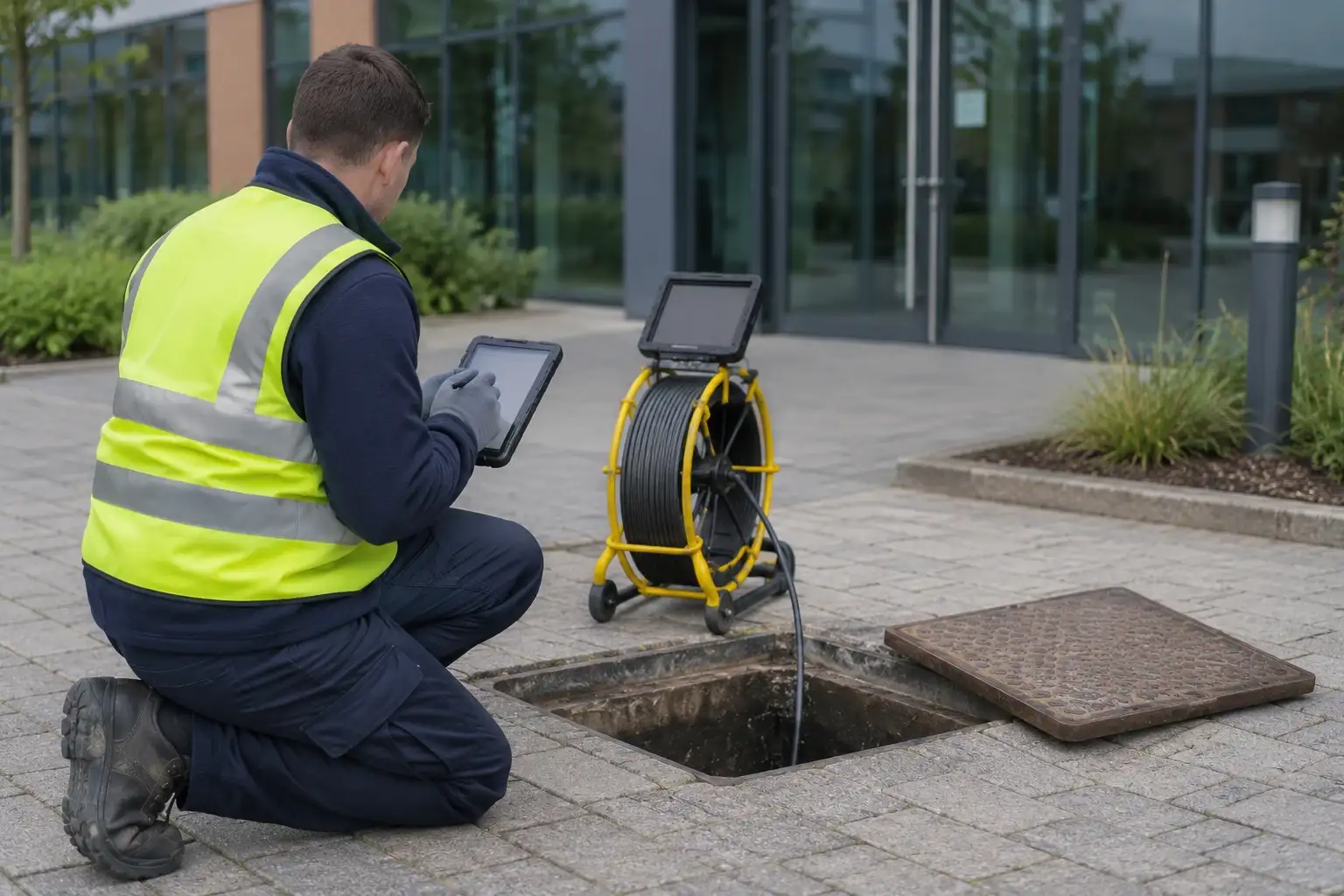
What a CCTV drain survey report should include (and how to read it)
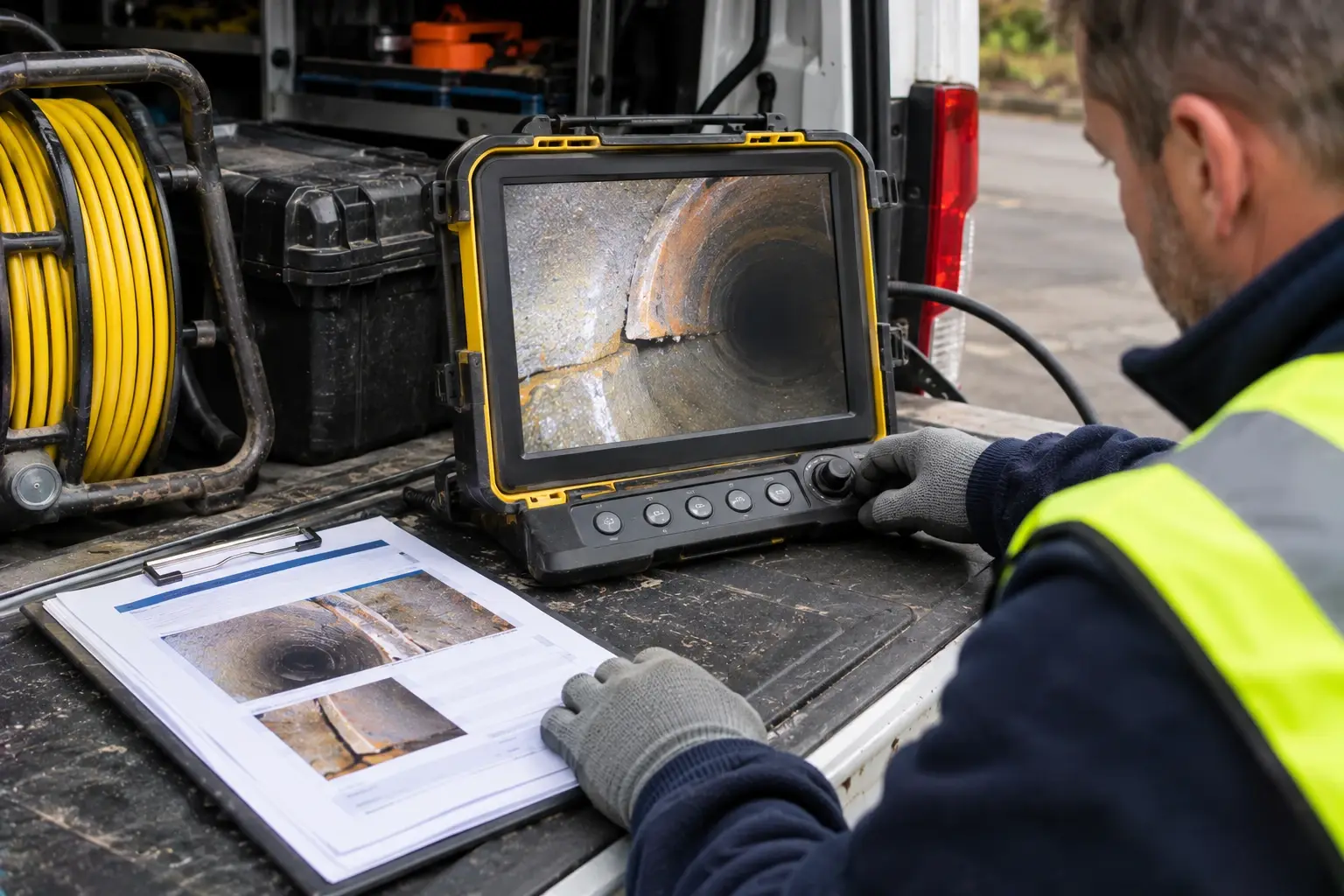
A proper CCTV drain survey report gives you a drain plan, a schedule of manholes and pipe runs, the footage itself, and coded observations for every defect, recorded to the WRc Manual of Sewer Condition Classification (MSCC, currently the 5th edition). Each run should carry a structural and a service grade from 1 (acceptable) to 5 (worst), followed by prioritised, costed recommendations you can act on.
When does a commercial site need a CCTV drain survey?
A survey is worth commissioning whenever you need evidence rather than guesswork. The common triggers on commercial sites are:
- Recurring blockages. Jetting treats the symptom. A survey shows whether the cause is a displaced joint, roots, a back fall or fat build-up. See signs a commercial drain is failing.
- Acquisition, disposal or a new lease. The RICS professional standard on technical due diligence of commercial property says underground services will not be subject to specialist inspection or testing unless the client specifically instructs it, so a drainage survey usually has to be commissioned separately. See drainage due diligence for commercial property.
- Insurance claims and disputes. Dated, coded footage is the clearest record of condition at a point in time. Check your policy wording for what your insurer expects.
- Pre-adoption. If you want a water company to adopt a private sewer or lateral drain, expect its condition to be assessed first. Southern Water’s guidance on adopting existing sewers says this can be done by “carrying out a Close Circuit Television survey (CCTV) and a physical inspection”. It also says the owner is responsible for the cost of the survey, the sewer location plans and any preliminary cleansing.
- Before and after works. A pre-works survey records the condition of the drains before contractors arrive. A post-works survey proves that repairs, relining or new connections were done properly before you sign off and release payment.
- A baseline for planned maintenance. A survey at the start of a PPM contract sets the benchmark that later surveys are measured against.
What should a proper CCTV drain survey report contain?
A usable commercial report should contain the following.
| Section | What to look for |
|---|---|
| Site details and scope | Address, date, the surveyor’s name, the reason for the survey, what was and wasn’t surveyed, and whether the drains were cleaned before the survey |
| Drain plan | A scaled or annotated plan of the network showing manholes, pipe runs, direction of flow, connections, and foul and surface water marked separately |
| Manhole/chamber schedule | Each chamber with a unique reference, cover type, depth to invert and condition, ideally with a photo |
| Run references | Each pipe run identified by its start and finish node (e.g. MH1 to MH2), matching the plan |
| Survey direction | Whether each run was surveyed upstream or downstream, and the flow direction |
| Pipe details | Material, diameter/height, shape (circular, egg, rectangular), and any existing lining |
| Survey length | The distance surveyed against the expected length, with the reason for any abandoned survey |
| Coded observations | Every defect and feature, recorded with its distance from the start, clock position, standard code and description |
| Footage | Video for every run, with the timestamp and distance shown on screen and cross-referenced in the observation log |
| Photographs | Stills of each significant defect, labelled with run reference and distance |
| Grades | A structural and a service grade for every run |
| Recommendations | What to do, where (run and distance), why, how urgent it is and the likely cost |
WRc’s XML data specification for MSCC5 inspection records makes start and finish node references, survey direction, inspection method, the standard used and pre-cleaning mandatory header fields. Each observation carries a distance and, for CCTV, a video time reference. Without them, nobody can find the defect on site or compare it with a future survey.
What is MSCC5, and why does it matter?
The Manual of Sewer Condition Classification is published by WRc. It is the UK coding system for recording what a CCTV camera sees inside a drain or sewer. WRc created its first defect coding structure in 1980, and the current edition is the 5th, published in 2013 (MSCC5). It is generally described as the UK interpretation of BS EN 13508-2:2003+A1:2011, the European visual inspection coding standard, which BSI still lists as current. Water UK’s Standards Board noted in April 2026 that a sixth edition (MSCC6) is in development, but at the time of writing MSCC5 is the edition in use.
MSCC5 does not say whether a drain is good or bad. It provides standard codes to describe what the camera sees: cracks, fractures, deformation, displaced joints, roots, deposits, infiltration and so on. Each code is recorded with its position along and around the pipe. Because every coder uses the same vocabulary, surveys from different contractors can be compared, even years apart.
Grading is the next step. The coded observations are scored, and the scores are converted into condition grades. In UK practice, WRc says the condition grading is generated using its Sewerage Risk Management (SRM) methodology. WRc’s approval listings for reporting software describe the software as using MSCC5 and BS EN 13508-2 codes, with grades “scored 1 to 5 where grade 5 is the worst condition”.
What do structural and service grades 1 to 5 actually mean?
Every run gets two separate grades, and they measure different things.
Structural grade refers to the physical condition of the pipe and how likely it is to collapse. Survey reports and training material commonly summarise the SRM structural grades along these lines, though the exact wording varies between reports:
| Grade | Meaning |
|---|---|
| 1 | Acceptable structural condition |
| 2 | Minimal likelihood of collapse in the short term, but potential for further deterioration |
| 3 | Collapse unlikely in the near future, but further deterioration likely |
| 4 | Collapse likely in the foreseeable future |
| 5 | Collapsed or collapse imminent |
Service grade refers to how well the pipe carries flow: deposits, roots, encrustation, obstructions and other things that reduce capacity and cause blockages. Broadly, grade 1 means the pipe is clear with no significant loss of performance, higher grades mean increasing loss of capacity and blockage risk, and grade 5 is generally used for a run that is blocked or close to it.
Three points help when reading grades:
- Grades are per run, not per site. A site can have nine grade 1 runs and one grade 5. That one run is what needs attention.
- The worst defect usually drives the grade. Software typically grades a run on its worst section, so one badly displaced joint can make an otherwise sound 20-metre run grade 4. Check the observation log to see what caused the grade.
- Structural and service grades can disagree. A sound pipe full of fat may be structural 1 and service 4. Jetting can improve the service grade but does nothing to repair the structure. A cracked pipe running clear may be the reverse. Reading the two grades separately tells you whether you need jetting and blockage clearance, a repair, or both.
A grade shows condition, not priority. A grade 3 defect under a busy service yard may matter more than a grade 4 under soft landscaping, and good recommendations reflect that.
What do reporting software outputs look like?
Most contractors use specialist reporting software, and WRc runs an approval scheme for these packages. A typical output includes a summary, a site plan, a run-by-run sheet with a graphical “pipe strip” of defects, an observation table, photos and linked video. Many packages can also export the data, which helps if you hold asset data in a CAFM or GIS system. A well-presented report built on poor coding is still a poor report.
Crawler or push-rod camera: does it matter?
It can. The two main types of camera system suit different jobs:
- Push-rod cameras are pushed along the pipe on a semi-rigid cable. They suit smaller drains, shorter runs and tight bends.
- Crawler cameras are wheeled, remote-controlled units for larger pipes and longer runs. They often have pan-and-tilt heads for looking directly at defects and into connections.
Many commercial sites need both. Ask which system will be used on which runs, and why.
What should you ask a contractor before you commission a survey?
- Will observations be coded to MSCC5 and graded using the WRc SRM method?
- What CCTV coding training or certification do the surveyors hold?
- Will the drains be cleaned before the survey, and is that included in the price?
- Will you get a drain plan, manhole schedule, full footage and exportable data?
- Will recommendations be prioritised, costed and kept separate from the findings?
- Will runs that can’t be surveyed be listed, with reasons?
This matters because coding takes skill. In a 2024 WRc article on an AI sewer assessment project, WRc principal consultant Peter Henley said: “Studies have shown that the accuracy of CCTV surveys can be as low as 30%”.
What are the red flags in a poor survey report?
- No grades, or one grade for the whole site. You can’t prioritise without per-run grades.
- Plain-English descriptions with no standard codes. The findings can’t be checked or compared.
- No drain plan, or plan references that don’t match the observations.
- No distances or timestamps. Nobody can find the defect on site.
- Footage missing or cut to “highlights”.
- Abandoned runs with no explanation.
- Heavy debris and no record of cleaning. Defects may be hidden underneath.
- Recommendations out of proportion to the defects. A full reline proposed for a grade 2 joint, or lining for every run regardless of condition, is worth a second opinion.
- “Repair as required” with no location or cost.
How long does a CCTV drain survey report stay useful?
There’s no fixed expiry date. A report records the condition on the day of the survey. It goes out of date faster where there’s heavy use, a commercial kitchen, mature trees, ground movement, recent excavation nearby, or defects already graded 3 or above. Use it as the baseline for your servicing regime, with repeat surveys of key runs and a fresh survey after significant works or a change of use. For transactions, buyers will usually want a recent survey rather than one inherited from a previous owner.
Key takeaways
- Insist on MSCC5 coding and structural and service grades for every run.
- A usable report links plan, manhole schedule, footage, photos and coded observations.
- Structural and service grades lead to different fixes.
- Grades show condition. Location and use decide priority.
- Recommendations should be located and costed. See our cost guide for typical ranges.
Sources
- WRc – Sewer CCTV condition assessment training: https://www.wrcgroup.com/headlines/bite-sized-views/sewer-cctv-condition-assessment-training/
- WRc Approved – Drainify CCTV Reporting Software (MSCC5, BS EN 13508-2 and SRM grades 1–5): https://www.wrcgroup.com/services/wrc-approved/approved-products-and-services/drainify-cctv-reporting-software/
- WRc – New world first for WRc with Ofwat-funded AI sewer assessment tool (March 2024): https://www.wrcgroup.com/headlines/bite-sized-views/new-world-first-for-wrc-with-ofwat-funded-ai-sewer-assessment-tool/
- WRc – XML Specification for MSCC5 Sewer Inspection Data (UC9774.02, February 2014): https://srm.wrcplc.co.uk/Data/Sites/2/GalleryImages/WebImages/Background%20of%20SRM/XML%20Draft%20Specification%20for%20MSCC5%20Sewer%20Inspection%20Data_February%202014_final%20draft.pdf
- NBS Publication Index – Manual of sewer condition classification (edition history): https://www.thenbs.com/PublicationIndex/documents/details?Pub=WRc&DocID=253779
- BSI – BS EN 13508-2:2003+A1:2011 Visual inspection coding system: https://knowledge.bsigroup.com/products/investigation-and-assessment-of-drain-and-sewer-systems-outside-buildings-visual-inspection-coding-system
- RICS – Technical due diligence of commercial property, 1st edition (published January 2020; reissued as an RICS professional standard in April 2023): https://www.rics.org/content/dam/ricsglobal/documents/standards/Technical_Due_Diligence_Of_Commercial_Property_1st_Edition.pdf
- Southern Water – Adoption of Existing Sewers Guidance Notes: https://www.southernwater.co.uk/media/e2the5q5/adoption-of-existing-sewer-guidance-notes.pdf
- UKSTT – When standards exist but progress stalls: https://www.ukstt.org.uk/when-standards-exist-but-progress-stalls/
- Water UK Standards Board – IGN 4-00-04 Issue 1, Certification requirements for sewer CCTV survey operatives in AMP8 (April 2026): https://standards-board.water.org.uk/wp-content/uploads/2026/04/IGN-4-00-04-Issue-1-published-280426.pdf
Questions
Is there a newer edition than MSCC5?
Not as of October 2026. Water UK's Standards Board said in April 2026 that MSCC6 is in development, but no sixth edition had been published when this was reviewed.
Is a grade 5 always an emergency?
A structural grade 5 is the worst condition and is generally taken to mean the pipe has collapsed or collapse is imminent, so it needs prompt attention. How urgent the fix is in practice depends on where the run is and what it serves.
Can jetting change a survey grade?
Jetting can improve a service grade by removing deposits, fat or roots. It doesn't repair structural defects, so it won't improve a structural grade, and it can expose structural defects that the debris was hiding.
Why was part of my drain not surveyed?
Common reasons are a blockage that couldn't be cleared, a collapse, a buried or inaccessible chamber, or a bend the camera couldn't pass. A good report records each one and proposes a next step.
Do I own the footage and data?
You should agree that before the survey. Ask for full video files and the underlying data, not just a PDF, so another contractor can review or build on the work later.