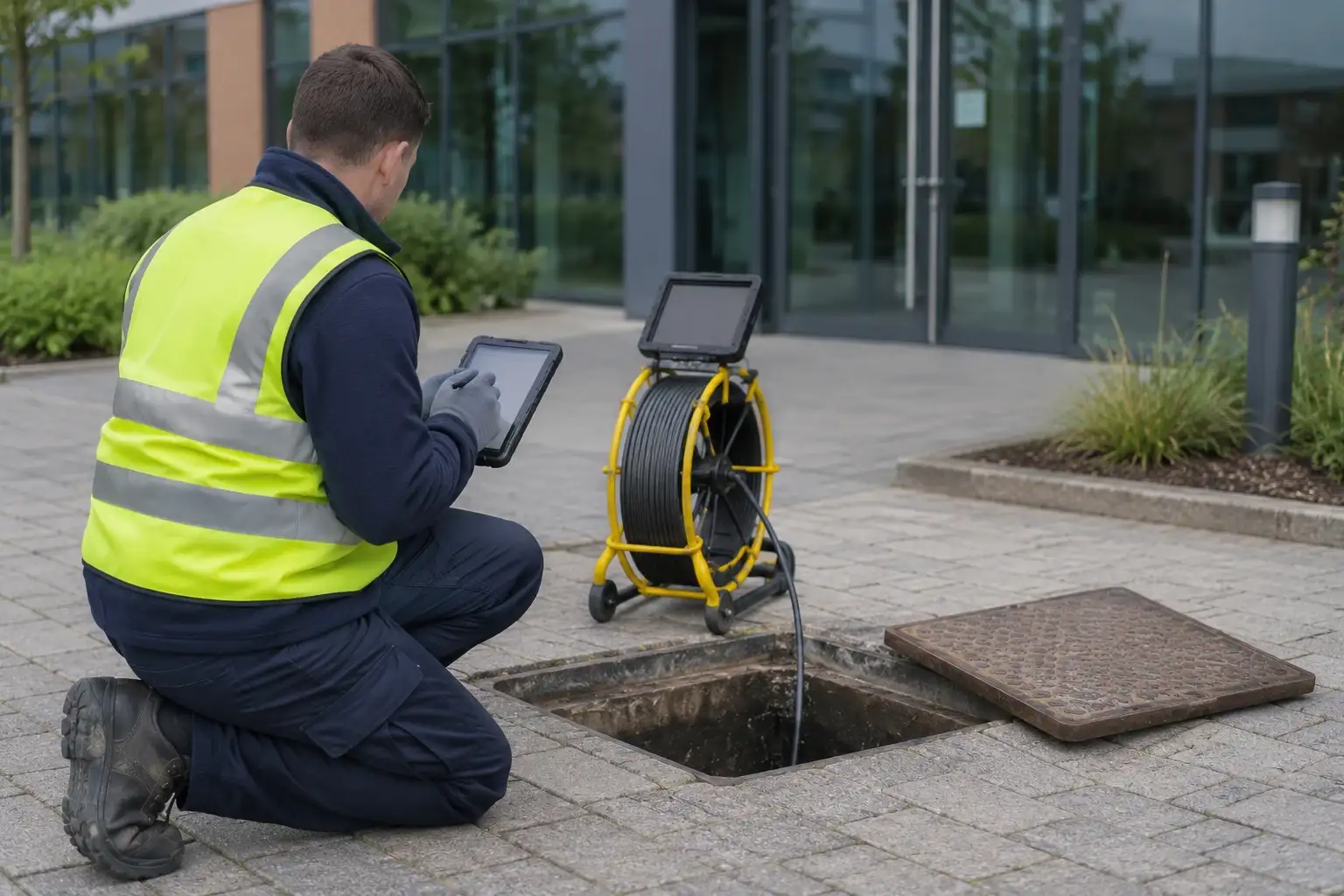
Who is responsible for drains on a commercial or multi-let site?
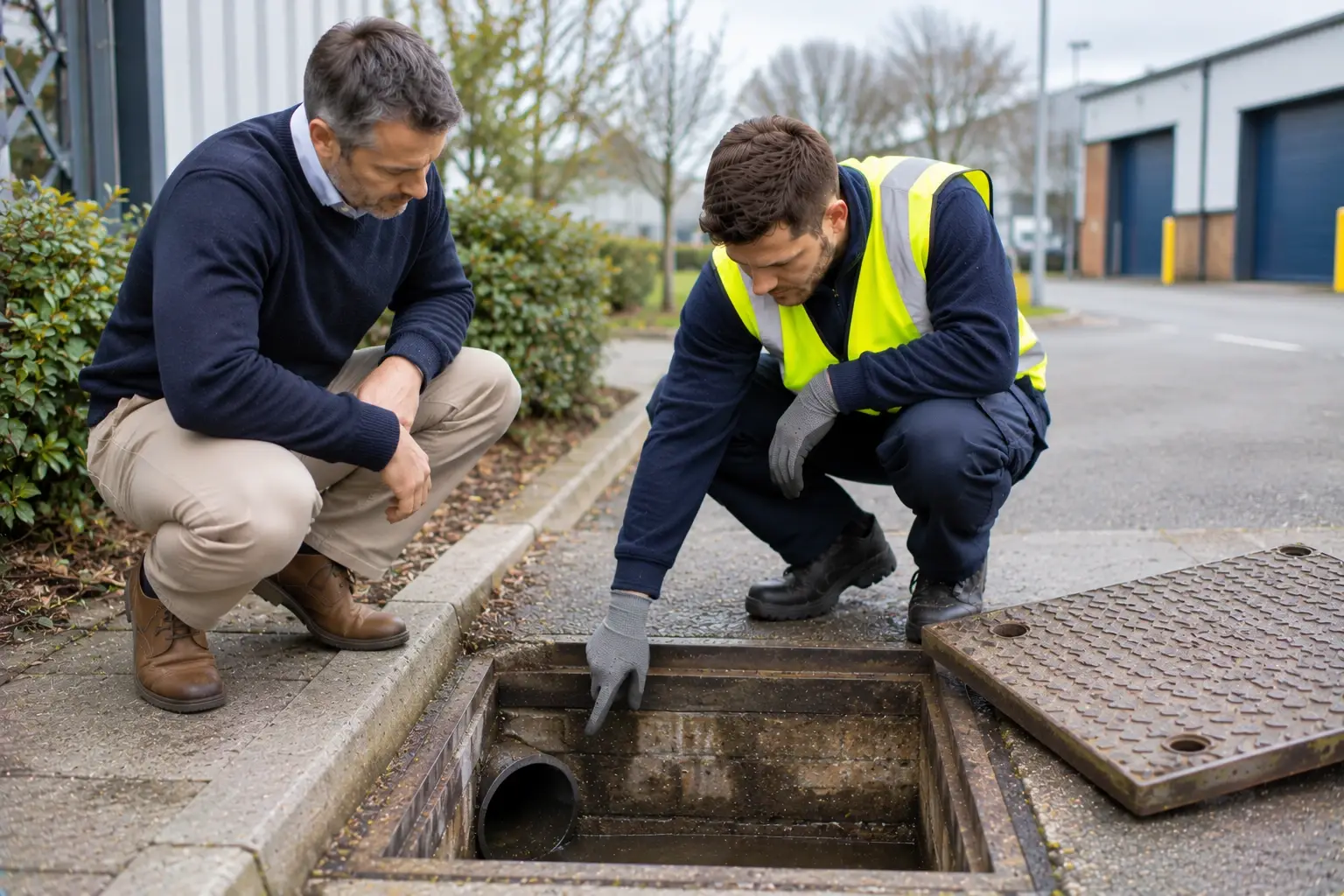
In England, drains serving a single property and sitting within its boundary (its “curtilage”) are generally the owner’s responsibility. Pipes shared with other properties, and pipes outside the boundary that connect to the public sewer, usually belong to the water company. On a multi-let site, who pays for the private drains then comes down to the lease: check your lease and service charge provisions.
Getting this wrong costs money either way. You might pay a contractor for a pipe the water company should fix, or wait for a water company that won’t come because the problem is on private drainage.
What’s the difference between a drain, a lateral drain and a sewer?
The terms have specific meanings, and ownership follows them.
| Term | What it is | Usually responsible |
|---|---|---|
| Drain | A pipe serving one property, within that property’s boundary | The property owner (or occupier, depending on the lease) |
| Lateral drain | A pipe serving one property, but running outside its boundary to connect to the public sewer | The water company, where it connects to a public sewer |
| Sewer | A pipe serving more than one property | The water company, where it connects to a public sewer, even if it runs under private land |
| Highway drain | A surface water drain that drains an adopted road | The highway authority (usually the county or unitary council) |
Mid Sussex District Council, for example, lists lateral drains and public sewers as Southern Water’s or Thames Water’s, and highway drains as West Sussex County Council’s. Thames Water says owners are responsible for pipes within their boundary “so long as they serve just your property”, while shared sewers are the water company’s “even if they are under your garden or driveway”. That guidance is written for households, but the principle is the same for commercial premises.
What changed on 1 October 2011?
Under transfer schemes made under the Water Industry (Schemes for Adoption of Private Sewers) Regulations 2011, and according to Defra’s guidance, on 1 October 2011 all privately owned sewers and lateral drains that connected to an existing public sewer as at 1 July 2011 transferred to the relevant water and sewerage company. Thames Water says that after this change in the law it “became responsible for private sewers/drains from 1 October 2011”.
What did not transfer?
This is where many commercial owners get caught out. The following generally stayed private:
- Drains serving a single property within its own curtilage. Defra’s guidance states these “remain the responsibility of the property owner or occupier”.
- Systems not connected to the public sewer, such as those draining to septic tanks, cesspools or private treatment plants.
- Surface water sewers and drains that discharge to a river, watercourse or soakaway rather than to the public sewer.
- Above-ground pipework. Water UK’s template guidance notes that gutters, downpipes and other above-ground plumbing serving two or more premises is not a sewer or a drain, so it did not transfer.
- Drains vested in a highway authority, and pipes owned by railway undertakers or on Crown land where an opt-out applied.
- Pipes connected after 1 July 2011. The transfer only caught pipes connected to the public sewer by that date. A newer private sewer is only public if the water company has adopted it.
Why “curtilage” matters on commercial sites
Defra’s guidance says a single curtilage “may contain a number of individual properties under common ownership (such as a shopping mall)”. In that case, the drains within the site can remain private even though they serve several units. They only become public where they leave the curtilage and connect to the public sewer.
So on shopping centres, retail parks, business parks and industrial estates in single ownership, the internal network may well still be private. Commentators noted at the time that it was unclear which commercial or industrial sites would be treated as a single curtilage, so for a major repair or a dispute, ask the water company for its view on that site.
Who is responsible on a single-occupier site?
On a site with one occupier, the private drains within the boundary are generally the responsibility of whoever the lease makes responsible:
- Freehold owner-occupier: you own and maintain the private drains.
- Tenant on a full repairing and insuring (FRI) lease of the whole building: the tenant usually repairs and pays, which normally includes the drains. Check how the lease defines the premises and whether it mentions “conduits” or “service media”.
- Tenant on an internal repairing lease: the landlord usually keeps the structure and external elements, which may include drainage. Check your lease.
Whatever the lease says, councils have powers over private drains in disrepair. Section 17 of the Public Health Act 1961, for example, lets a council carry out minor repairs to a drain or private sewer that is not kept in good repair, after giving at least seven days’ notice, and recover its costs from “the person or persons concerned”.
Who is responsible on a multi-let site?
On a multi-let building or estate, responsibility is usually split like this:
| Element | Typical responsibility | Typical cost route |
|---|---|---|
| Drains exclusively serving one unit, within the demise | Tenant of that unit | Tenant pays directly |
| Shared drains, manholes, interceptors and common parts drainage within the site | Landlord, often via a managing agent | Recovered through the service charge |
| Drainage in car parks and service yards | Landlord (common parts) | Service charge |
| Public sewers and lateral drains | Water company | Normally the water company’s cost |
On many multi-let buildings, tenants repair their own units and reimburse the landlord for a share of the cost of the structure and common parts through the service charge. The RICS professional standard on commercial service charges is clear that all expenditure a landlord seeks to recover “must be in accordance with the terms of the lease”, and that the standard “cannot override the lease”. If drainage maintenance, CCTV surveys or planned preventative maintenance are not within the lease’s service charge provisions, recovery may be challenged.
Managing agents should map which runs are shared and which serve one unit, check the service charge schedule covers drainage repair, cleaning, surveys, interceptors and pump stations, and record condition with a CCTV drain survey in case of later disputes.
Who pays when one tenant causes a blockage?
If a blockage in a shared private drain can be traced to one occupier, such as fat from a restaurant kitchen or wipes from one unit, the landlord will want to recharge that tenant rather than spread the cost across everyone. Whether you can depends on the lease. Look for:
- A tenant covenant not to obstruct or damage the drains, or not to put harmful substances into them.
- An indemnity or recharge clause for damage caused by the tenant’s use.
- Provisions for grease traps or interceptors serving that unit, and who must maintain them.
Evidence matters: CCTV footage showing where the blockage started and what it was made of is what makes a recharge stick.
Where the waste reaches the public sewer, Southern Water states that businesses are required by law “to make sure their waste does not block or damage the sewer network, under Section 111 of the Water Industry Act 1991”, and it advises food businesses to fit a grease separator. For more on this, see our guide to commercial kitchen grease management.
Trade effluent
Discharging trade effluent to the public sewer needs the water company’s prior written consent; Southern Water states that doing so without consent is an offence under section 118 of the Water Industry Act 1991. On multi-let sites, check who holds any consent and that tenants’ uses are covered.
What about pumping stations?
Private pumping stations followed a later timetable. Defra’s guidance states they would transfer between 1 October 2011 and 1 October 2016. Pumping stations only qualified where they were on pipework that transferred on 1 October 2011.
Defra’s guidance also states that a pumping station and rising main serving one property and within that property’s curtilage would not transfer. So a pumping station serving a single-ownership commercial site may still be private, leaving its servicing, alarms and repair with the owner or tenant under the lease. If unsure, ask the water company, and keep it on a pump station servicing schedule meanwhile.
Who deals with surface water and highway drainage?
- Road gullies and highway drains: the highway authority’s. Southern Water states that “local councils are responsible for road gullies”.
- On-site surface water (car parks, roofs, yards) draining to a soakaway or watercourse: generally private, and often a common parts cost on multi-let sites.
- Surface water draining to a public sewer: the sewer is the water company’s; the private drains on your side of the connection are not.
How do you find out who owns a pipe?
- Check water company sewer records. Southern Water makes its maps available online through its partner Digdat (for a fee) or free to view by appointment at its office. Thames Water offers a paid asset location search, and free map viewing by appointment.
- Know the limits of those records. Southern Water says its maps “will not show any private pipework” and “may not always show all public sewers”. Thames Water says many of the sewers transferred in 2011 “don’t appear on our records”. A pipe missing from the map is not proof that it’s private.
- Survey it. A CCTV survey with drain tracing shows where pipes run, what they connect to and where responsibility changes hands. On older or extended sites it is often the only way to settle the question. See our guide to reading a CCTV drain report.
- Apply the rules. If the pipe serves more than one property, or runs outside your curtilage to a public sewer, contact the water company before paying for works.
Where does insurance fit in?
On multi-let sites the landlord usually insures the building and recovers the premium through the service charge; under an FRI lease the tenant may insure or reimburse the premium. Whether drain damage is covered depends on the policy wording, so ask your broker whether underground pipes are included, what exclusions apply and what evidence an insurer will want.
Checklist: before you pay for drain works
- Does the pipe serve only your property, within your boundary?
- Is it on, or plausibly missing from, the sewer records?
- What does the lease say about repair, the demise and the service charge?
- Is there evidence of which occupier caused the problem?
- Is it actually highway drainage?
- Does the building insurance cover underground drainage?
Sources
- Defra, Provisional non-statutory guidance on private sewers transfer (June 2011, revised September 2011): https://assets.publishing.service.gov.uk/government/uploads/system/uploads/attachment_data/file/69356/private-sewers-transfer-guidance110928.pdf
- Water UK, Transfer of Private Sewers Regulations 2011: General Principles to assist in applying the Regulations: https://www.water.org.uk/sites/default/files/wp/2019/03/Transfer-of-Private-Sewers-Regs-2011-Water-UK-template.pdf
- Thames Water, Sewer pipe responsibility: https://www.thameswater.co.uk/help/water-and-waste-help/sewer-flooding/sewer-pipe-responsibility
- Thames Water, Transfer of private sewers: https://www.thameswater.co.uk/help-and-advice/drains-and-sewers/transfer-of-private-sewers
- Thames Water, Finding out if a sewer is mapped: https://developers.thameswater.co.uk/Domestic-and-small-commercial/Building-near-pipes/Building-over-or-near-a-sewer/Do-you-need-approval/Finding-out-if-a-sewer-is-mapped
- Thames Water, Where our pipes are: https://www.thameswater.co.uk/developers/larger-scale-developments/planning-your-development/where-our-pipes-are
- Southern Water, Sewer and water maps: https://www.southernwater.co.uk/mains-and-sewer-maps
- Southern Water, Flooding: who’s responsible: https://www.southernwater.co.uk/help-advice/flooding/flooding-who-s-responsible
- Southern Water, Managing FOG in your food business: https://www.southernwater.co.uk/help-and-support/managing-fat-oil-and-grease-fog-food-businesses/
- Southern Water, Trade effluent consent: https://www.southernwater.co.uk/commercial/trade-effluent-businesses/trade-effluent-consent/
- Mid Sussex District Council, Drains and sewers: https://www.midsussex.gov.uk/environment-net-zero/drains-and-sewers
- Public Health Act 1961, section 17: https://www.legislation.gov.uk/ukpga/Eliz2/9-10/64/section/17
- RICS, Service charges in commercial property (professional standard, 2nd edition, effective 31 December 2025): https://www.rics.org/profession-standards/rics-standards-and-guidance/sector-standards/real-estate-standards/service-charges-in-commercial-property
Questions
Does the water company have to clear a blocked lateral drain serving my unit?
If the lateral drain runs outside your property's boundary and connects to a public sewer (and was connected by 1 July 2011 or has since been adopted), it is generally the water company's responsibility. Inside the boundary, the drain is private.
Are the drains on a shopping centre or business park public?
Not necessarily. Where a site sits in one ownership and forms a single curtilage, its internal drains can remain private even though they serve several units, until they leave the site.
Can a landlord put drainage costs on the service charge?
Only if the lease allows it. RICS guidance confirms that recoverable costs must follow the lease terms.
Who pays if a tenant's grease blocks a shared drain?
That depends on the lease's covenants and recharge provisions. CCTV evidence of the cause makes recharging far more straightforward.
Are post-2011 drains on a new development public?
Not automatically. Pipes connected after 1 July 2011 only become public if the water company adopts them.