Grease management for commercial kitchens: FOG rules, grease traps and enforcement
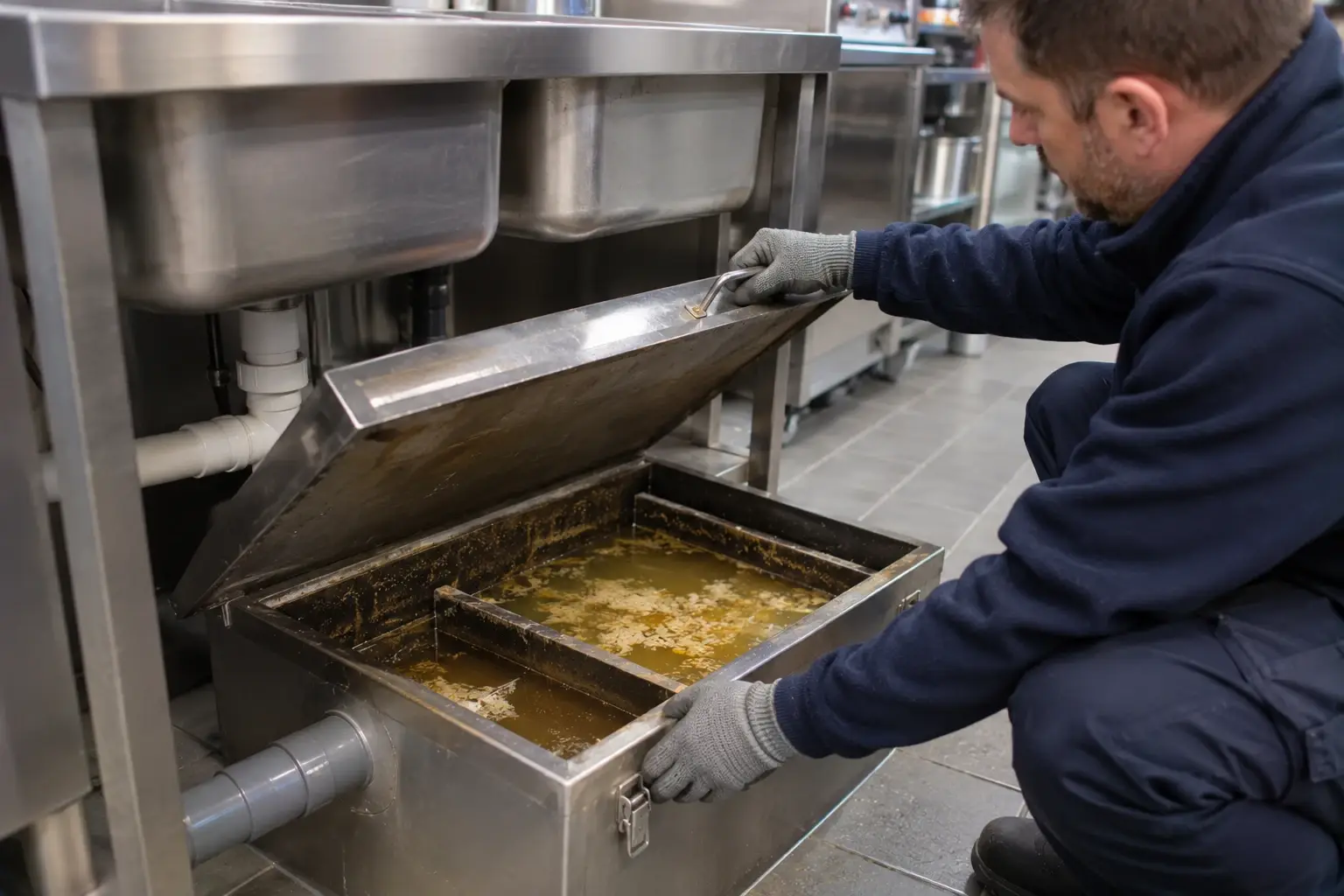
Commercial kitchens must keep fats, oils and grease (FOG) out of the public sewer. Putting anything into a drain or sewer connected to the public sewer that is likely to block it is a criminal offence under section 111 of the Water Industry Act 1991, and water companies inspect and prosecute. In practice, that means suitable grease separation equipment, regular servicing, good kitchen habits and records that prove it.
Why is FOG such a problem for drains?
Hot fat and oil go down the sink as a liquid, then cool and set inside the pipe. Water UK’s foodservice guidance explains that FOG “sticks to the inside of pipes and solidifies”, gradually narrowing the bore until wastewater can’t get past. Combine that with wipes and other unflushables and you get the fatbergs that make the news.
The scale is significant. According to the same guidance:
- over 300,000 sewer blockages happen in the UK every year, and up to 70% are caused by FOG and other material disposed of incorrectly down drains
- clearing them and cleaning up the flooding and pollution they cause costs approaching £200 million a year
Thames Water alone says it removes 75,000 blockages from its sewers every year, at a cost of £18 million a year.
For a site operator, the more immediate risk is closer to home. Grease usually builds up first in your own private drains. That shows up as slow sinks, smells, backed-up gullies and, eventually, an emergency callout during service. If you’re not sure where your responsibility ends and the water company’s begins, see our guide to who is responsible for commercial drains.
What does the law require?
Several pieces of legislation overlap. The main ones for a food business in England are set out below.
| Law or guidance | What it means for a kitchen |
|---|---|
| Water Industry Act 1991, section 111 | It’s an offence to put anything into a public sewer, or a drain or sewer connected to one, that is likely to interfere with the free flow of its contents. Thames Water says penalties can include an unlimited fine or even imprisonment. |
| Building Regulations, Approved Document H (H1) | Paragraph 2.21: drainage serving kitchens in commercial hot food premises “should be fitted with a grease separator complying with BS EN 1825-1:2004 and designed in accordance with BS EN 1825-2:2002 or other effective means of grease removal”. This applies to building work such as new or altered drainage, so it is usually picked up at fit-out or refurbishment. |
| Environmental Protection Act 1990 (waste duty of care, section 34) | Waste FOG, trap contents and used cooking oil are business waste. They must only be transferred to an authorised person, such as a registered waste carrier, with a written description of the waste. |
| Animal by-products rules | Water UK’s guidance notes that, under the Animal By-Products Regulation, waste cooking oil from catering premises can no longer be used as an ingredient in animal feed, and advises using a licensed waste carrier. |
Approved Document H describes the expected standard rather than imposing a blanket legal duty on every existing kitchen. However, the section 111 offence applies to every site, old or new. In practice, the water company will judge whether whatever you have in place actually keeps grease out of the sewer.
How do Southern Water and Thames Water enforce it?
Across Sussex, Kent and Hampshire, the sewerage undertaker is generally Southern Water. In much of Surrey and the London fringe, it is Thames Water.
Southern Water says its Network Protection Enforcement Officers “inspect food business kitchens” to check that fat, oil and grease are being disposed of correctly. It warns that FOG blockages can cause flooding, costly repairs and potential closure, and that businesses that don’t dispose of FOG correctly risk prosecution. Its guidance points kitchens to section 111 and the Building Regulations requirement for a grease separator “or other effective means of removing grease”, and says separators should be cleaned and maintained regularly.
Thames Water states plainly that discharging fats, oils, greases and food waste into sewers is illegal. It expects businesses to keep records of waste collections so they can prove their contractor is licensed and registered.
Enforcement is real, and it usually follows years of warnings:
- China Panda, Fulham (2025). According to Thames Water, the takeaway was prosecuted at Reading Magistrates Court on 25 April 2025 and ordered to pay a combined £13,090 in fines and costs. Thames Water had made several attempts since 2018 to engage with the business, including the installation of a grease management trap. Further blockage reports in 2022 and 2023 found the trap was not maintained by China Panda. Thames said it takes legal action “as a last resort where the risk is too high”.
- Kolak Snack Foods Limited and Taiko Foods Limited (2024). These were food manufacturers rather than kitchens. Even so, the cases show where the scale can go. At Willesden Magistrates Court in October 2024, Thames Water reports that Kolak was fined £152,000 and ordered to pay a further £16,000 to Thames Water (£168,000 in total) over effluent containing food solids and fats, and Taiko was fined £88,500 and ordered to pay £6,000 in costs (£94,500 in total) over the disposal of chemicals, solids and fats.
The China Panda case is the warning for most operators. The equipment was there, but it wasn’t maintained.
Which grease management options work?
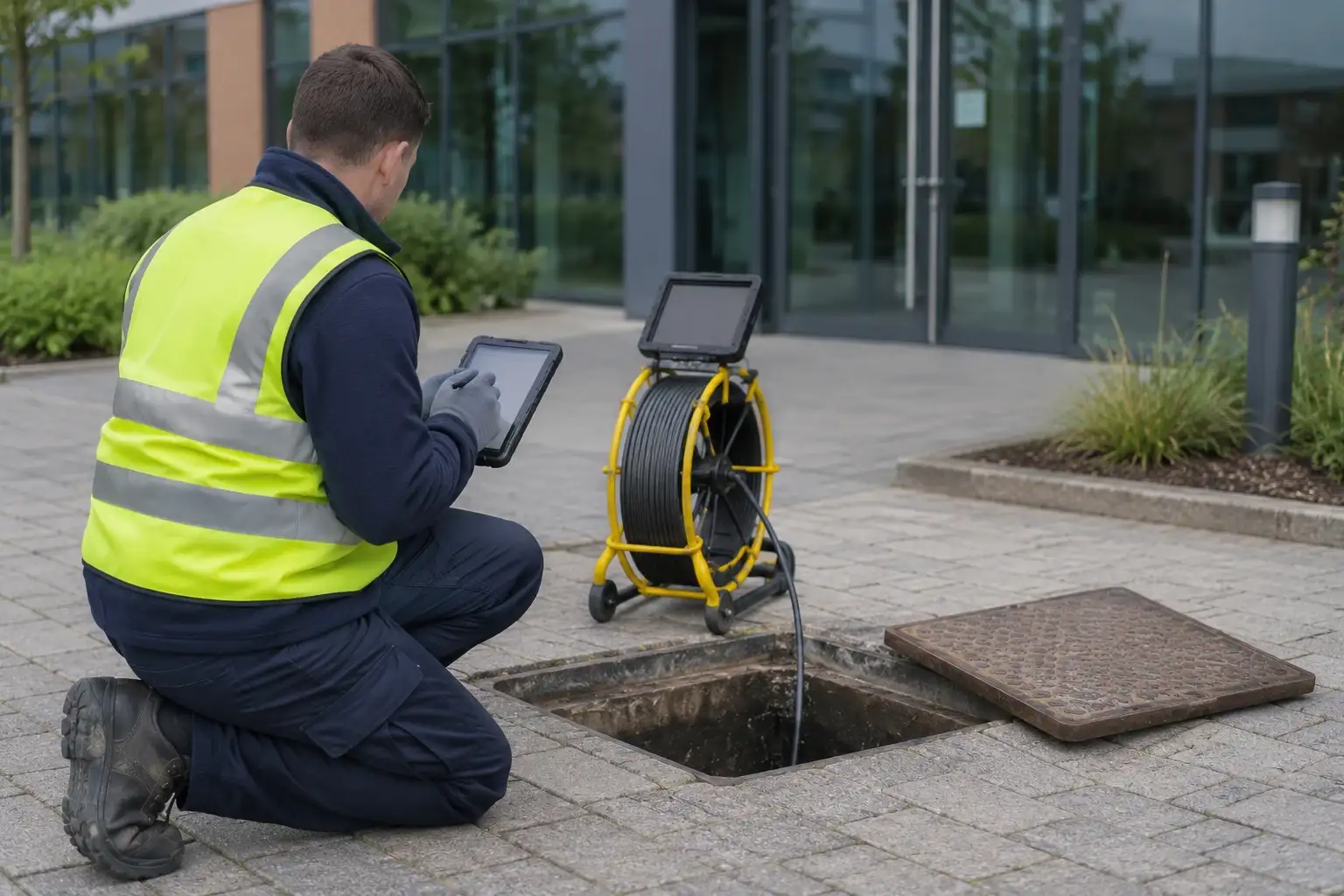
There’s no single right answer. The best choice depends on cover numbers, menu, available space and whether you’re fitting out or retrofitting. A drainage survey of the kitchen run is a sensible starting point; our CCTV drain surveys show where grease is already settling.
| Option | How it works | Typical maintenance (per Water UK guidance) | Watch-outs |
|---|---|---|---|
| BS EN 1825 grease separator | Large passive gravity tank, usually below ground or in a basement. FOG floats and is retained. | Unless otherwise specified, emptied, cleaned and refilled with clean water at least once a month, preferably every two weeks | Needs space and a vacuum tanker for servicing. Fine food solids and detergents affect performance. |
| Small passive grease trap (non-EN 1825) | Under-sink or point-of-use box, ranging from 20–400 litres | Daily maintenance, with filter baskets emptied at least daily | Easy to install but easy to neglect. A full trap does nothing. |
| Grease removal unit (GRU) | Powered unit that skims FOG into a collection container | May need emptying and cleaning daily (Thames Water says GRUs “need to be emptied every day”) | Needs electricity and staff discipline. Not compatible with biological dosing upstream of it. |
| Biological dosing | Bacteria dosed into the drain to break down FOG | Typically serviced monthly, quarterly or six-monthly, depending on system | Water UK notes it does not physically intercept FOG. Bacteria may not survive in some conditions, so wastewater should be analysed first. |
| Enzyme products | Enzymes intended to break down fats | As per manufacturer | Water UK warns that enzymes do not work under some conditions. Treat them as a supplement, not a substitute for physical separation. |
Two other points from the Water UK guidance are worth knowing:
- Detergents, chemicals, and the volume and temperature of wastewater all affect how well downstream separation works.
- Where food waste disposal units are installed, they should never be used to discharge FOG into drains or sewers.
How often should grease traps be serviced?
Follow the manufacturer’s specification and your water company’s guidance. As a rule of thumb from Water UK’s guide:
- GRUs may need emptying and cleaning daily.
- Small traps need daily maintenance.
- BS EN 1825 separators need emptying at least monthly, and preferably every two weeks.
Busy kitchens, high-fat menus and undersized equipment may need more frequent visits.
Separate equipment servicing from drain line cleaning. A well-run trap reduces grease reaching the drain, but some always gets through. Periodic high-pressure jetting of kitchen runs is commonly included in a planned maintenance contract. Our guide on how often to service commercial drains covers intervals in more detail.
What should kitchen staff be doing?
Equipment only works alongside good habits. Thames Water and Water UK guidance agree on the basics:
- Scrape and dry-wipe plates, pans and utensils into the bin before washing.
- Fit sink strainers to catch food solids, and empty them into the food waste bin.
- Never pour oil or fat down sinks or floor drains.
- Collect used oil in sealed containers, stored safely, for collection by a licensed contractor.
- Sweep up food debris and put it in the bin, rather than sweeping it into floor drains.
- Train staff, allowing for staff turnover, and make sure they understand why it matters.
- Have an oil spill plan, so spills never go down drains.
What records should you keep?
If a water company officer or council inspector visits, you need to show your system works. Water UK’s guidance suggests keeping:
- staff training records
- in-house maintenance records for traps and GRUs
- records of contractor maintenance and call-outs
- waste transfer notes for each load of waste that leaves the premises, including FOG, trap waste and used cooking oil
GOV.UK guidance says to keep waste transfer notes, on paper or electronically, for two years. For repeated collections of the same non-hazardous waste by the same carrier, a “season ticket” can cover up to a year. You keep a schedule of each collection alongside it, keep both for two years after the last transfer, and show them to an enforcement officer from your local council or the Environment Agency if asked.
Does Simpler Recycling affect kitchens?
Yes. Under England’s Simpler Recycling reforms, businesses and workplaces with 10 or more full-time equivalent employees have had to separate food waste for collection since 31 March 2025. Micro-firms with fewer than 10 full-time equivalent employees have until 31 March 2027 to comply. The rules cover food leftovers and waste from food preparation.
This doesn’t change drainage law. It does mean every qualifying kitchen should already have a proper food waste bin, which makes “scrape, don’t rinse” much easier to enforce.
Key takeaways
- Section 111 of the Water Industry Act 1991 applies to every kitchen, not just new ones.
- Where drainage work is done in a hot food kitchen, Approved Document H expects a BS EN 1825 grease separator or other effective grease removal.
- A common failure is unmaintained equipment, not missing equipment, as the China Panda case shows.
- Dosing and enzymes have limitations and are best treated as a supplement to physical separation.
- Keep training logs and service records, and keep waste transfer notes for at least two years.
- Use our drainage compliance checklist to audit each site.
Sources
- Southern Water: Managing fat, oil and grease (FOG) in your food business
- Thames Water: Preventing blockages for food businesses
- Thames Water: London based takeaway prosecuted for continuous sewer abuse offences (8 May 2025)
- Thames Water: Food companies ordered to pay for severe sewer abuse offences (12 November 2024)
- Water UK: Foodservice – Fat, Oil and Grease Management Guide (March 2023)
- GOV.UK: Approved Document H – Drainage and waste disposal (2015 edition)
- legislation.gov.uk: Water Industry Act 1991, section 111
- legislation.gov.uk: Environmental Protection Act 1990, section 34
- GOV.UK: Dispose of business or commercial waste – waste transfer notes
- GOV.UK: Simpler Recycling – workplace recycling in England
Questions
Is it illegal to pour cooking oil down the sink in a restaurant?
Yes, in practice. Putting anything into a public sewer, or a drain connected to one, that is likely to interfere with its free flow is an offence under section 111 of the Water Industry Act 1991. FOG is the classic example, and Thames Water states that discharging fats, oils, greases and food waste into sewers is illegal.
Do existing kitchens have to install a grease trap?
Approved Document H applies to building work, so the separator expectation usually bites at fit-out or refurbishment. But any kitchen whose FOG causes blockages risks enforcement, so in practice most commercial kitchens need effective grease management.
What is the difference between a grease trap and a GRU?
A passive trap or separator holds wastewater so grease floats and is retained until it is emptied. A GRU is a powered unit that actively skims grease into a container that staff empty, often daily.
Can we rely on bio-dosing instead of a trap?
Water UK's guidance notes that dosing doesn't physically intercept FOG and won't work in every kitchen's conditions. Check with your water company before relying on it alone.
Who collects used cooking oil?
A registered waste carrier. You should get a waste transfer note for each collection, or a season ticket with a collection schedule, and keep it for two years.
Who pays if grease from our kitchen blocks a shared drain?
It depends on where the blockage is, who owns that section of drain, and what your lease says. Check your lease, and see our guide to commercial drain responsibility.