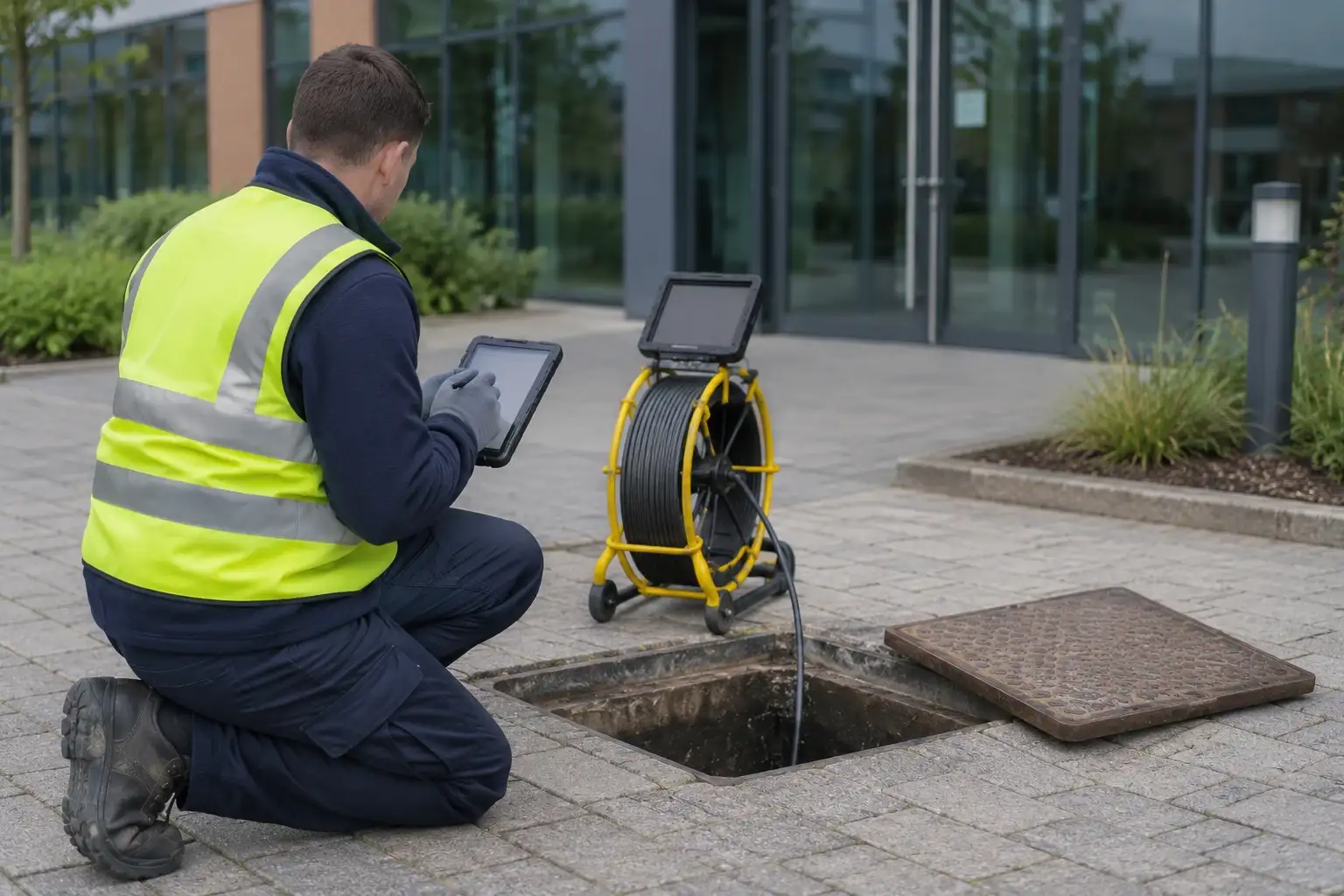
How often should commercial drains be serviced?
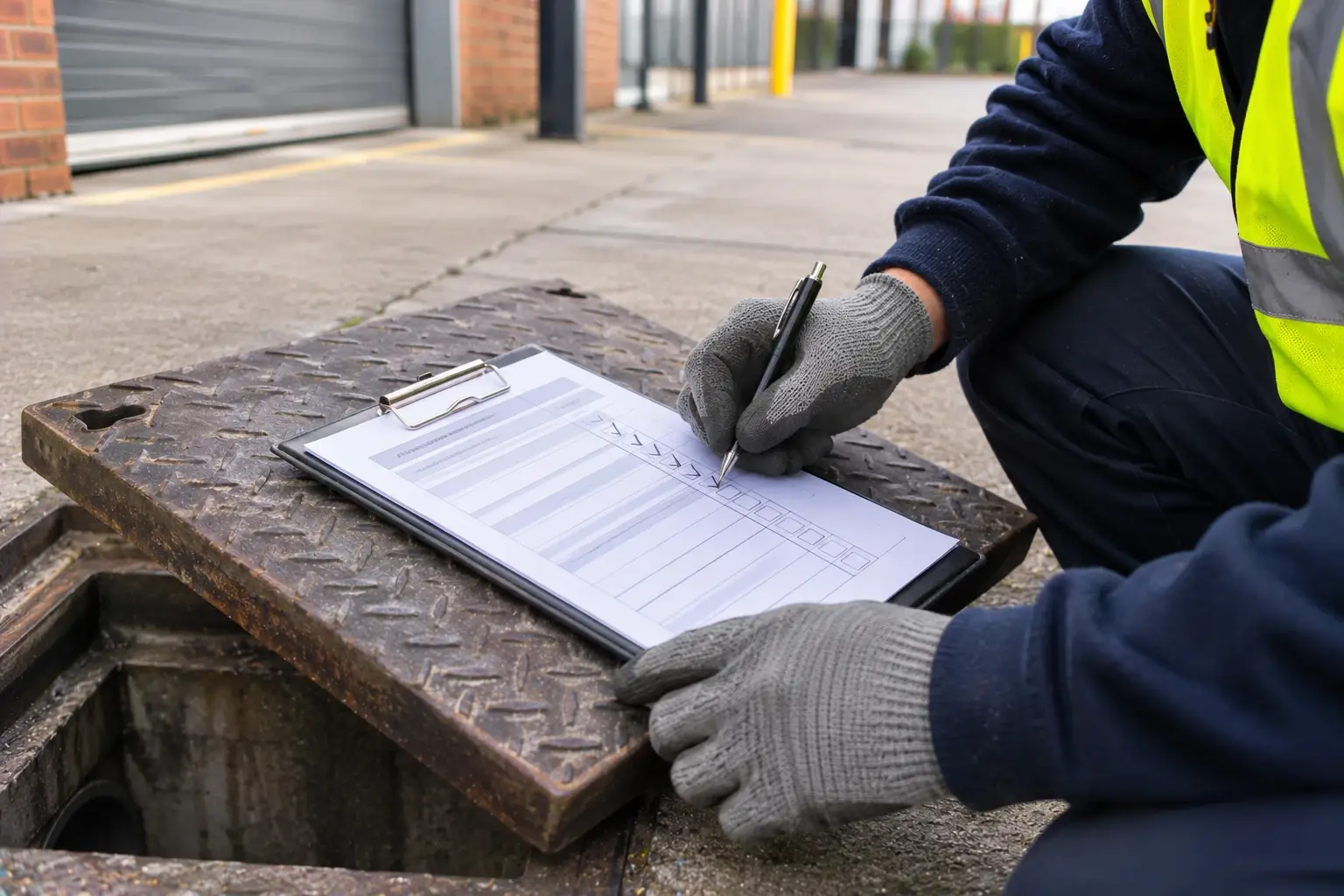
Commercial drain runs are commonly serviced every 6 to 12 months, but busy kitchens, food retail and industrial yards often need quarterly or monthly visits. Some assets have firmer minimums: GOV.UK guidance, citing British Standards, says oil separators should be checked at least every 6 months and integrity tested at least every 5 years. The right schedule depends on your sector, your assets and what a baseline CCTV survey shows.
Why is there no single answer?
Frequency is driven by what goes into the system and what happens if it fails:
- What goes down the drain. Fat, oil and grease (FOG) from kitchens, silt and fuel from yards and car parks, and wipes and sanitary waste from washrooms all build up at different rates.
- The assets on site. A simple gravity system needs far less attention than one with grease separators, oil interceptors, pumping stations or attenuation tanks.
- Condition. Root ingress, displaced joints, sags and scale make blockages more likely, so a drain in poor condition needs more frequent attention than a sound one.
- Criticality. A blockage in a hospital kitchen or a block of flats causes far more disruption than one in a little-used outbuilding.
For that reason, most frequencies you will see quoted, including the ones below, are industry convention rather than law. The exceptions are a handful of assets where government or water industry guidance sets a clearer minimum, and even that is guidance rather than a fixed legal interval.
Recommended frequencies by sector
These are typical starting points used across the industry for planned preventative maintenance (PPM). They are not legal requirements. Treat them as a baseline to adjust once you know the condition of your system.
| Sector | Typical main drain inspection and jetting | Other items to plan for |
|---|---|---|
| Commercial kitchens and hospitality | Every 3 months; monthly for high-volume kitchens | Grease separators and GRUs (see asset table), kitchen gullies |
| Retail | Every 6 to 12 months; more often for food halls and in-store kitchens | Car park gullies and any oil separator |
| Offices | Every 12 months | Washroom stacks, basement pump stations |
| Industrial and logistics | Every 3 to 6 months | Oil separators, yard gullies, silt traps |
| Healthcare | Every 3 to 6 months, given the impact of disruption | Kitchen grease management, pump stations |
| Education | Every 6 to 12 months, ideally timed for school holidays | Kitchen grease management, playground and car park gullies |
| Managed residential blocks | Every 12 months | Communal stacks, shared pump stations, surface water |
Recommended frequencies by asset
| Asset | Typical frequency | Is the minimum set in guidance? |
|---|---|---|
| Main drain runs (gravity) | Inspect every 6 to 12 months; jet as condition requires | No – industry convention |
| Gullies and channel drains | Every 6 to 12 months; before winter for car parks | No – industry convention |
| Grease removal units (GRUs) | Often emptied daily by staff, depending on how much FOG the kitchen produces; planned maintenance visits at least twice a year | Yes – Water UK FOG guidance (Thames Water says GRUs need emptying every day) |
| Grease separators (BS EN 1825) | Emptied, cleaned and refilled at least monthly, preferably every two weeks | Yes – Water UK FOG guidance (subject to the manufacturer’s instructions) |
| Oil separators and interceptors | Checked at least every 6 months; integrity test at least every 5 years; emptied when oil or silt builds up, after a spill or when an alarm activates | Yes – GOV.UK pollution prevention guidance, referencing British Standards |
| Pump stations | Service every 6 to 12 months; quarterly for critical or heavily used stations | Follow the manufacturer’s operation and maintenance (O&M) manual |
| Soakaways | Inspect every 6 to 12 months; remove silt when it builds up | No – design-specific; follow the drainage maintenance plan |
| Attenuation tanks | Inspect every 6 months; silt removal commonly every 1 to 2 years | No – design-specific; follow the drainage maintenance plan |
What sets the minimums where they exist?
Oil separators
The GOV.UK guidance on pollution prevention for businesses says you should check your separator regularly, noting that British Standards recommend checking it at least every 6 months. The guidance tells you to check how much oil and silt has built up and that all parts are working. It also says separators should have an integrity test at least every 5 years, and should have full service and maintenance records available for inspection.
GOV.UK also says that, since 1 January 2021, separators supplied in England, Wales and Scotland have been legally required to have an automatic warning device or high-level alarm. Trapped oil and sediment is hazardous waste and must be moved under a hazardous waste consignment note to a permitted facility.
GOV.UK does not name the standard, but the British Standard covering the operation, inspection and maintenance of separators for light liquids such as oil and petrol is BS EN 858-2.
Grease traps and grease removal units
Water companies are clear on the law but less prescriptive on frequency. Southern Water reminds food businesses that, under Section 111 of the Water Industry Act 1991, they are required by law to make sure their waste does not block or damage the sewer network, and that its Network Protection Enforcement Officers inspect food business kitchens. It says grease equipment should be cleaned and maintained regularly but does not set an interval. Thames Water says grease removal units need to be emptied every day, and that businesses should keep a record of collections.
The most specific figures come from Water UK’s FOG guidance for food service businesses. It says that, unless otherwise specified, BS EN 1825 grease separators should be emptied, cleaned and refilled with clean water at least once a month, and preferably every two weeks, with the manufacturer and operating experience guiding the actual regime. It says GRUs may need emptying and cleaning daily, depending on how much FOG the kitchen produces, with planned maintenance visits at least twice a year. For a fuller picture, see our guide to commercial kitchen grease management.
Pump stations
We have not found a regulation that sets a fixed servicing interval for a private pump station, so the manufacturer’s O&M manual is the main reference. As a rule of thumb, six-monthly servicing is common practice, moving to quarterly for critical stations or those with a history of call-outs.
Soakaways and attenuation tanks
Sustainable drainage systems (SuDS) should be maintained to the management plan prepared for them, and CIRIA’s SuDS Manual (C753) is the main industry reference. Susdrain, the SuDS resource created by CIRIA, describes three types of maintenance: regular, usually monthly, such as inspecting inlets, outlets and control structures; occasional, usually annual depending on the design, such as removing silt from catchpits, soakaways and cellular storage; and remedial, as required. Adoption guidance from at least one water company sets six-monthly walkover surveys for attenuation tanks and infiltration systems, with silt removal anticipated every 12 to 24 months.
Signs you need to service more often
Your current schedule is probably too light if you see:
- repeat blockages on the same run between planned visits
- slow-draining sinks, gullies or floor drains
- odours from gullies, manholes or kitchen drains
- grease, silt or debris found at depth on each visit
- surcharging (water rising in chambers) after heavy rain
- separator or pump station alarms activating
- a change of use, such as a new kitchen, more covers or longer opening hours
- rodent activity around drainage
Several are also early warnings of structural problems. See the signs a commercial drain is failing.
How do you set a schedule from a baseline CCTV survey?
Table frequencies are a guess until you know what is in the ground. A practical approach:
- Commission a baseline CCTV survey. Map the system and code defects. In the UK, surveys are usually coded to WRc’s Manual of Sewer Condition Classification (MSCC), now in its fifth edition. Our CCTV drain survey report guide explains how to read the results.
- Rank each run by risk. Combine survey condition with how critical each run is. A greasy kitchen run ranks above a clean office washroom run.
- Fix structural defects first. Jetting a run with roots or displaced joints only treats the symptom. Repair or relining can reduce the frequency you need.
- Set frequencies per asset, not per site. Apply the minimums above for separators and grease equipment, then set each run’s frequency by its risk ranking.
- Review after each cycle. If a run is consistently clean, extend the interval. If debris keeps returning, shorten it. Re-survey periodically, and after any significant works or change of use.
A planned maintenance contract built this way can cost less over time than one with a single fixed visit frequency for every asset.
What records should you keep?
Good records show compliance, support insurance claims and help you tune the schedule. Keep:
- Service reports for every visit: what was done, what was found, photos and recommendations.
- CCTV survey reports and footage, to compare condition over time.
- Oil separator service and integrity test records. GOV.UK guidance says full service and maintenance records should be available for inspection.
- Waste paperwork. The government’s waste duty of care code of practice says waste transfer notes should be kept for 2 years, and hazardous waste consignment notes (which apply to separator waste) for 3 years.
- Grease equipment logs, covering daily GRU emptying and collections. Thames Water advises keeping collection records so you can show your contractor is licensed and registered.
- Asset register and drainage plan, kept up to date when anything changes.
Responsibility for keeping these records often sits with the tenant, the landlord or the managing agent, depending on the lease. Our guide to commercial drain responsibility covers who usually does what.
Key takeaways
- Most drain frequencies are industry convention, not law. Set them by risk and condition.
- Oil separators: check at least 6-monthly, integrity test at least 5-yearly, keep records.
- Grease separators: empty at least monthly unless otherwise specified; GRUs often daily, with planned maintenance twice a year.
- Pump stations and SuDS: follow the O&M manual and drainage maintenance plan.
- A baseline CCTV survey makes the schedule fit your site.
Sources
- GOV.UK – Pollution prevention for businesses: https://www.gov.uk/guidance/pollution-prevention-for-businesses
- GOV.UK – Waste duty of care: code of practice: https://www.gov.uk/government/publications/waste-duty-of-care-code-of-practice/waste-duty-of-care-code-of-practice
- Southern Water – Managing fat, oil and grease (FOG) in your food business: https://www.southernwater.co.uk/help-and-support/managing-fat-oil-and-grease-fog-food-businesses/
- Thames Water – Preventing blockages for food businesses: https://www.thameswater.co.uk/wholesale/best-practice-for-food-businesses
- Water UK – Foodservice: Fat, Oil and Grease Management Guide (Version 1, March 2023): https://www.water.org.uk/sites/default/files/2023-09/Foodservice_Fat_Oil_Grease_0.pdf
- Susdrain (CIRIA) – SuDS maintenance: https://www.susdrain.org/delivering-suds/using-suds/adoption-and-maintenance-of-suds/maintenance/index.html
- CIRIA – The SuDS Manual (C753): https://www.ciria.org/CIRIA/Books/Free_publications/C753F.aspx
- WRc – Sewer CCTV condition assessment training (MSCC): https://www.wrcgroup.com/headlines/bite-sized-views/sewer-cctv-condition-assessment-training/
Questions
Is there a legal requirement to service commercial drains at set intervals?
Generally not for ordinary drain runs. Firmer minimums apply mainly to oil separators under GOV.UK guidance, and food businesses must not block the public sewer, which in practice means regular grease management.
How often should a restaurant's grease trap be emptied?
Water UK guidance says that, unless otherwise specified, BS EN 1825 grease separators should be emptied at least monthly, and preferably fortnightly. GRUs may need emptying daily, and Thames Water says they need emptying every day. A very busy kitchen may need more frequent visits than these minimums.
Do offices need planned drainage maintenance?
Yes, though usually lighter, often a yearly inspection. Pump stations, staff kitchens or car park separators need adding at their own intervals.
How often should we have a CCTV drain survey?
There is no fixed rule. Start with a baseline, then re-survey after recurring problems, significant works, a change of use or a property transaction.
Can servicing too often damage drains?
Jetting by a competent operator generally should not damage a sound drain, but it can worsen existing defects, which is another reason to survey first.
Who pays for drainage maintenance in a multi-let building?
It depends on the lease. Shared drainage is often maintained by the landlord and recovered through the service charge, while tenants may be responsible for their own kitchen grease equipment. Check your lease.