Signs a commercial drain is failing (and what ignoring them costs)
The main signs a commercial drain is failing are slow drainage, repeat blockages, gurgling, sewer smells, water rising in manholes, pooling, sunken paving, cracking near drain runs and rat activity. One sign on its own may be minor. Several together, or any that keep coming back, usually point to a defect that needs a CCTV survey. Ignoring them can leave you with uninsured damage, pollution liability and enforcement action.
Drains rarely fail without warning. The trouble is that the warnings land with different people: the kitchen team notices slow sinks, the cleaners notice the smell, the grounds contractor notices sunken paving. Nobody connects them until the line backs up.
What are the warning signs of a failing commercial drain?
Treat the middle column as a starting point. Only a survey confirms the cause.
| Warning sign | What it usually indicates | What to do |
|---|---|---|
| Slow drainage across several outlets | A partial blockage building up (fat, silt, scale, roots) or a dip in the pipe where debris settles | Monitor. If it affects more than one outlet or gets worse, book jetting and a CCTV survey |
| Recurring blockages in the same run | An underlying defect such as a displaced joint, root ingress, a collapse or a back fall. Jetting clears the symptom, not the cause | Commission a CCTV drain survey rather than paying for repeat clearances |
| Gurgling from gullies, sinks or WCs | Air being pulled through traps as water struggles to pass a restriction, or a ventilation problem | Monitor alongside other signs. If it comes with slow drainage, treat it as a developing blockage |
| Foul odours or sewer smells | Dried-out traps, a cracked or broken pipe letting gases escape, or waste standing in a chamber | Check traps on little-used outlets first. Persistent smells near a run warrant a survey |
| Pooling water in yards, car parks or around gullies | Blocked or silted gullies, a failed soakaway or a collapsed surface water pipe | Clear the gully. If water still stands, investigate the surface water and soakaway system |
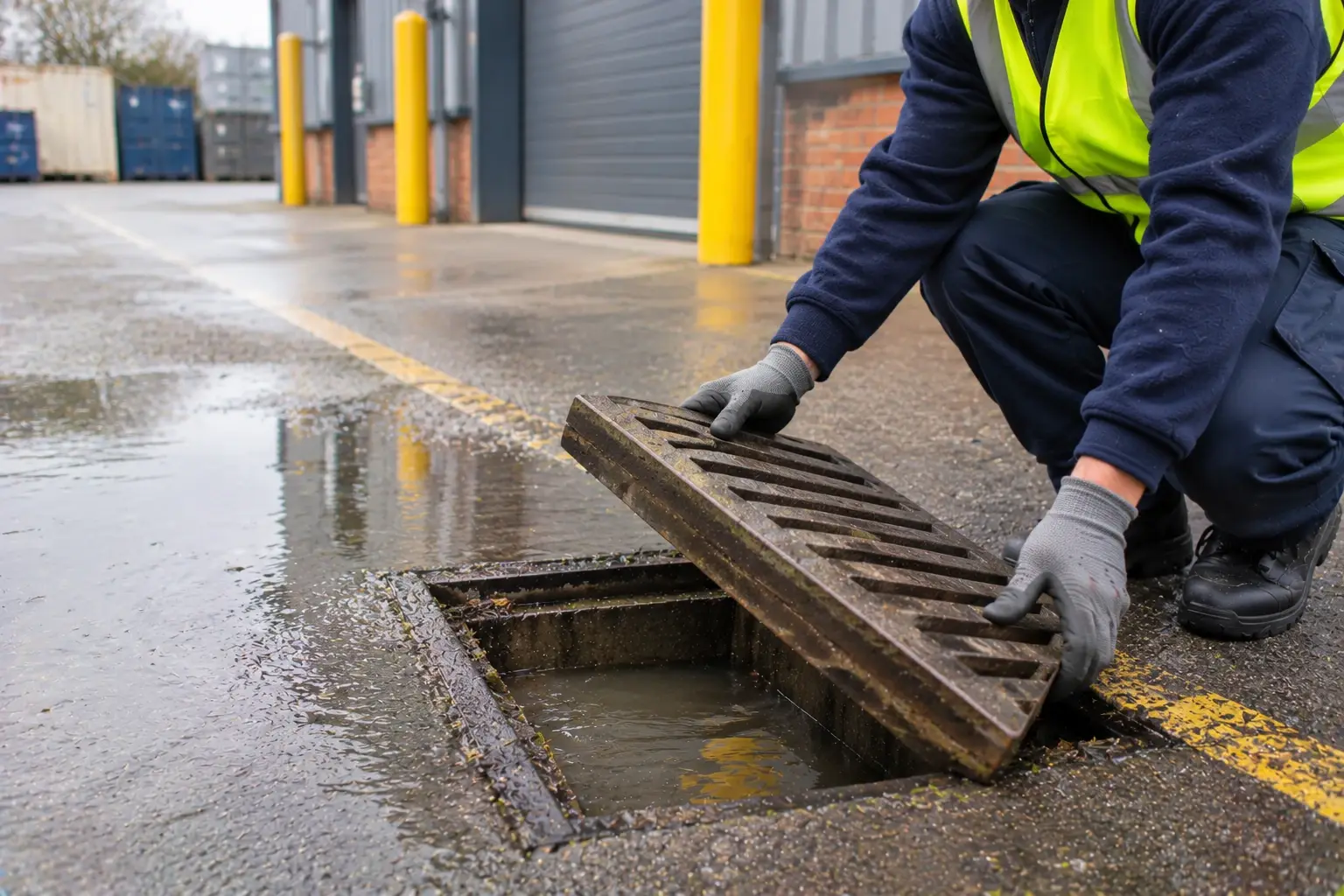
| Rising water in chambers or manholes | A blockage downstream of that chamber. If the chamber nearest the public sewer is also full, the problem may be in the public sewer | Treat as urgent. Lift covers in sequence to locate the blockage and call for clearance |
| Damp patches, sunken paving or subsidence near a drain run | Water escaping from a cracked or leaking pipe and washing away the soil around it | Survey promptly. Leaking drains are a recognised cause of subsidence |
| Cracked walls close to drain runs | Possible ground movement linked to a leaking drain, though cracks have many other causes | Have the drains surveyed before structural work, so the cause is fixed and not just the crack |
| Rat activity inside or around the building | Rats getting in through broken pipework, a defective chamber or an uncapped disused connection | Bring in pest control and survey the drains, as baiting alone will not close the entry point |
| Overflowing gullies or interceptor alarms | A blocked outlet, or an oil separator or grease trap that is full or overdue for emptying | Respond immediately. Arrange emptying and servicing before polluting material escapes |
| Unexplained high water bills | A leak on your supply pipework rather than a drainage fault, but the escaping water can saturate ground and enter drains | Take meter readings with water off to check for flow, and contact your water retailer |
A closer look at the signs that need the most care
Rats. An article from the British Pest Control Association states that it is estimated that, on average, 80% of rat infestations within the home originate from drainage. That figure relates to homes, not commercial premises, but similar entry routes can apply on commercial sites: defective drains, poorly capped redundant pipes and gaps in inspection chambers. Reading Borough Council’s rat factfile advises checking that drainage is in good repair “as rats can access the house via broken pipe work”. Thames Water’s advice notes that rats can enter a property through a gap as small as 1.5cm, and says property owners have a legal responsibility to keep the property rodent-free under the Prevention of Damage by Pests Act 1949.
Subsidence and cracking. LV= lists “leaking drains, which wash away the subsoil below your foundations” among the main causes of subsidence, with diagonal cracks at the edges of windows and doors as a typical sign. The Financial Ombudsman Service makes the same point about escape of water: a significant or long-term leak “can wash away particles in the soil”. It also cautions that cracks do not automatically mean subsidence, which is why a survey should come before any repair.
Interceptor alarms. GOV.UK’s pollution prevention guidance for businesses in England notes that the British Standard says oil separators should be fitted with an automatic warning device or high level alarm, and that a separator should be emptied and serviced if any alarm activates. An alarm is a “deal with it today” signal.
Water bills. CCW’s leak allowance guidance says customers or landlords are normally responsible for external supply pipework from the boundary, and that an abnormally high bill is a reason to contact your retailer.
What does ignoring the signs cost a business?
The repair is often the smallest part of the bill.
Insurance may not cover it
The Financial Ombudsman Service lists the most common exclusions on claims for damage to underground pipes as gradual damage, wear and tear, and poor design, construction or workmanship. Its guidance is written for home and buildings insurance, and commercial property policies may contain similar exclusions. A drain that has been cracking slowly for years is the kind of damage those exclusions can apply to. A dated CCTV survey and a record of acting on its findings can help show the damage was not left to develop. Check your own policy wording, and your lease if you are a tenant.
Business interruption
A backed-up foul drain can close toilets, a kitchen or a whole unit until it is cleared and cleaned. Planned work on a defect found early can usually be scheduled around opening hours. An emergency on a Friday night cannot.
Pollution liability
GOV.UK’s pollution prevention guidance for businesses is direct: “You must not let your business or organisation cause or allow pollution.” If you pollute, “you could get an unlimited fine, go to prison for up to 5 years, or both”. The same guidance tells businesses to check drains regularly for blockages, leaks and misconnections, and warns that you “must fix any misconnections or you could be fined”. It adds that you may also have to pay for the whole cost of the clean-up.
A real example shows how this happens. On 9 January 2025, at Kirklees Magistrates’ Court, Huddersfield packing company Liquipak Ltd was ordered to pay £8,973.67, including a fine, victim surcharge and prosecution costs, after pleading guilty to an illegal discharge of bleach. In September 2021, bleach spilled in its warehouse went down a manhole that the company thought led to the foul sewer. It actually drained to a surface water drain leading to the river, and more than 800 dead fish were counted downstream. An Environment Agency officer said it is important that companies “understand their site drainage and the difference between surface and foul drains”. An up-to-date drainage plan, usually produced from a CCTV survey, is how you get that understanding.
If polluting material has entered, or could enter, a watercourse or the ground, GOV.UK says to call the Environment Agency’s 24-hour incident hotline on 0800 80 70 60 immediately.
Action by the water company
Thames Water states that it is a criminal offence under section 111 of the Water Industry Act 1991 to release anything into the public sewers that could interfere with the free flow of wastewater, and that offenders could face an unlimited fine or even imprisonment. For food businesses, a neglected grease trap that lets fat through is a common route to this kind of problem. Our guide to commercial kitchen grease management covers prevention.
Health and safety
Sewage and rats both carry health risks. HSE guidance notes that leptospirosis (Weil’s disease) is transmitted by rat urine and can be fatal, and it sets out what employers should do to protect staff exposed to sewage, including instruction and training, personal protective equipment and welfare facilities. A drain that floods a yard or plant room exposes people to those hazards.
The repair itself gets bigger
A cracked pipe can often be relined without digging. Left alone, it can collapse, and the job becomes excavation, replacement and reinstatement. For typical prices at each stage, see our commercial drainage cost guide.
When should you monitor, survey or call for emergency help?
Use this as a simple escalation guide. If in doubt, go up a level.
| Level | Typical signs | Action |
|---|---|---|
| Monitor | A single slow outlet, an occasional gurgle, a smell from a little-used trap | Note it in the site log, top up traps, check again within a week or two. Escalate if it spreads or repeats |
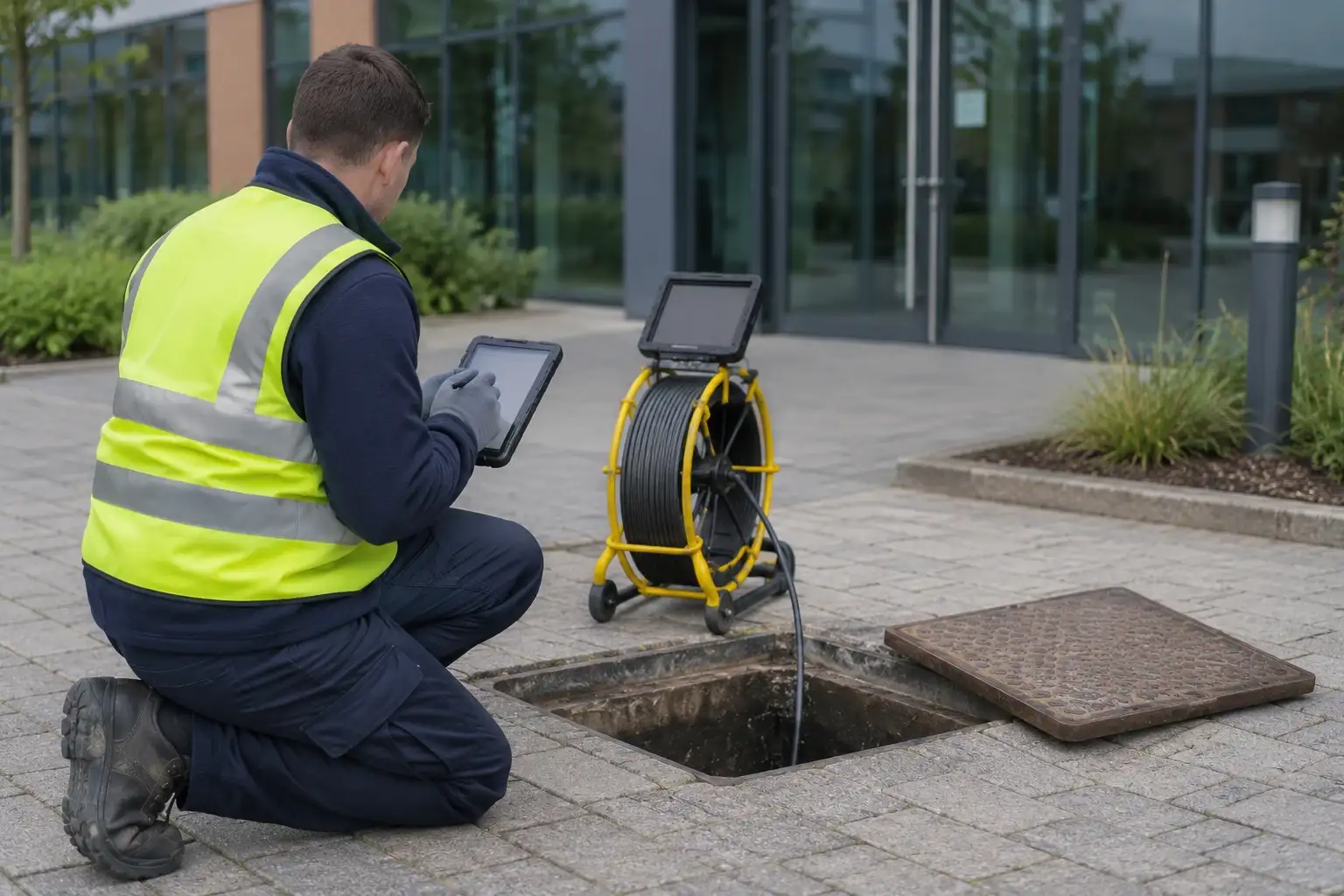
| Book a CCTV survey | Repeat blockages, persistent smells, rat activity, damp ground or sunken paving near a run, cracking near drains, anything before a lease end or acquisition | Commission a survey and report so repairs are based on evidence. Our CCTV report guide explains what you should get |
| Urgent call-out | Sewage surcharging from chambers or gullies, water rising in manholes, flooding inside the building, interceptor high-level alarms, any risk of pollution reaching a watercourse | Call for emergency response. If pollution could reach a watercourse or the ground, also call the Environment Agency hotline |
Key takeaways
- Repeat jetting of the same run means you need a survey, not another clearance.
- Rats, damp ground and cracking near drain runs need investigating, not just treating.
- Interceptor alarms and rising water in chambers are same-day problems.
- Policies often exclude gradual damage and wear and tear, so act early and keep records.
- Know which drains are foul and which are surface water.
Sources
- British Pest Control Association, “Drainage inspections for rodents”: https://bpca.org.uk/news/drainage-inspections-for-rodents/277883
- Reading Borough Council, “Rat factfile”: https://images.reading.gov.uk/2026/01/Rat-Factfile.pdf
- Thames Water, “Rats, rodents and pest control”: https://www.thameswater.co.uk/help/emergencies/rodents
- Thames Water, “Preventing blockages for food businesses”: https://www.thameswater.co.uk/wholesale/best-practice-for-food-businesses
- LV=, “What is subsidence”: https://www.lv.com/home-insurance/if-your-home-is-affected-by-subsidence
- Financial Ombudsman Service, “Subsidence and other types of ground movement”: https://www.financial-ombudsman.org.uk/consumers/complaints-can-help/insurance/home-insurance/subsidence-types-ground-movement
- Financial Ombudsman Service, “Damage to underground pipes”: https://www.financial-ombudsman.org.uk/businesses/complaints-deal/insurance/home-buildings-insurance/damage-underground-pipes
- GOV.UK, “Pollution prevention for businesses”: https://www.gov.uk/guidance/pollution-prevention-for-businesses
- GOV.UK, “Report an environmental incident”: https://www.gov.uk/report-an-environmental-incident
- GOV.UK, “Yorkshire company fined for polluting river with bleach”: https://www.gov.uk/government/news/yorkshire-company-fined-for-polluting-river-with-bleach
- CCW, “Leak allowances customer guidance”: https://www.ccw.org.uk/app/uploads/2023/03/Leak-Allowance-Customer-Guidance.pdf
- Health and Safety Executive, “Working with sewage: the health hazards” (INDG198): https://www.hse.gov.uk/PUBNS/indg198.pdf
Questions
Is a single blocked drain a sign the system is failing?
Not necessarily. One-off blockages are often caused by misuse, such as wipes or grease. It is repetition in the same run that suggests a structural defect.
Who pays if rats are coming from the drains?
Pipes inside your property boundary are generally your responsibility, while the public sewer belongs to the water company. Thames Water, for example, says that if rats are confirmed to be coming from its sewers, it can investigate and, if needed, repair the sewer. See our guide to commercial drain responsibility, and check your lease if you are a tenant.
Will our insurance pay for a collapsed drain?
It depends on the cause and your policy. Sudden accidental damage may be covered, but gradual damage and wear and tear are common exclusions in buildings policies. Ask your broker and keep survey records.
Can a leaking drain really cause structural cracks?
Yes, a long-term leak can wash away the soil beneath foundations and cause subsidence. Cracks have many other causes too, so survey the drains before carrying out structural repairs.
What should staff do if an interceptor alarm sounds?
Stop any activity that could add oil or contaminated water to the drains, report it to the facilities team and arrange emptying straight away. If anything has escaped towards a watercourse, call the Environment Agency hotline.