Drainage due diligence when buying or leasing commercial property

Drainage due diligence means finding out, before you commit, what drains serve the property, who is responsible for them, what condition they are in and what consents attach to them. In practice that means raising the right pre-contract enquiries, ordering a commercial drainage and water search, checking for build-over issues, and commissioning a CCTV survey before exchange or lease signing.
This is practical guidance, not legal advice: speak to your solicitor and surveyor about your specific transaction.
Why is drainage so often missed in commercial due diligence?
Mostly because the standard paperwork does not show the part of the system you are most likely to end up paying for.
- The searches show public assets, not private drains. A drainage and water search maps public sewers and water mains. Sample commercial search reports warn that there may be public sewers and lateral drains that are not shown on the public sewer map, and that records of sewers subject to adoption agreements are not an “as constructed” record.
- Private drains on your site are usually yours. When private sewers transferred to water companies on 1 October 2011, government guidance said that drains serving a single property and within its curtilage remain the responsibility of the owner or occupier. Its examples of single properties include offices and commercial buildings, hotels, and industrial, business and retail parks. See our guide to who is responsible for commercial drains.
- Underground defects are invisible on a walk-round. A building survey cannot see a collapsed pipe underground.
The cost of missing it can be excavation under a car park or slab, trading disruption, pollution clean-up, or a dilapidations claim for drains that were failing when you moved in.
What do the Commercial Property Standard Enquiries ask about drainage?
CPSE.1 is the general set of pre-contract enquiries used in most commercial transactions. It has no single “drainage” section, but several enquiries cover it if your solicitor follows them up. Enquiry numbers can change between versions, so ask your solicitor which apply to the version they are using:
| CPSE.1 enquiry | What it asks | Why it matters for drainage |
|---|---|---|
| Physical condition | Whether the property has been affected by defects, including defective Conduits, plant or equipment, and flooding | Prompts disclosure of known drain failures and flood history |
| Utilities and services | Details of services serving the property, whether connections are direct to a mains supply, and whether Conduits run from the highway without passing through other land | Reveals whether drains cross a neighbour’s land and need rights of drainage |
| Environmental: authorisations | Authorisations needed under environmental law for current activities, including discharges to sewers or controlled waters | Picks up trade effluent consents and discharge permits |
| Environmental: waste and effluent | How waste or effluent, including surface water, is disposed of, with copies of consents, agreements and correspondence | The key drainage enquiry: ask for drainage plans and service records too |
“Conduits” in CPSE.1 means the pipes, wires and cables through which utilities and other services are carried. That includes drains.
Replies such as “not aware” are common and mean you should carry out your own checks. Ask your solicitor to raise specific supplementary questions: drainage layout plans, CCTV reports, interceptor and grease trap service logs, pumping station maintenance records and any history of blockages or flooding.
Which drainage and water search should you order?
For commercial premises, order the commercial version of the drainage and water search, not the residential one. Names vary by provider. Southern Water calls its product the CommercialDW search and says it contains 24 questions, covering sewer and water asset information, sewer flooding history and connection status, plus extra details such as trade effluent consents. Other providers sell it as the CON29DW Commercial.
A sample CON29DW Commercial report includes questions on:
- whether foul and surface water drain to a public sewer, and whether a surface water drainage charge is payable
- whether any public sewer, lateral drain or pumping station is within the property boundary
- whether the sewerage undertaker has approved or been consulted about building over or near a public sewer
- whether the building is at risk of internal flooding from overloaded public sewers
- whether there is a trade effluent consent on the property under section 118 of the Water Industry Act 1991
Read the notes, not just the answers: the report warns that records may be incomplete.
Has anything been built over or near a public sewer?
Water companies control building close to their sewers. Southern Water requires a build-over application for building within 3 metres of a public sewer, and its guidance says that if a sewer under a structure fails, it would have to be repaired immediately, “even if it involved demolishing the structure”. For building work to existing properties, Thames Water requires a build-over agreement within 3 metres of a public sewer or within 1 metre of a public lateral drain.
If the search or site plans show a public sewer within the boundary, check:
- whether extensions, canopies, plant rooms or loading bays sit over or near it
- whether a build-over or sewer protection agreement exists (Southern Water guidance notes that a buyer’s solicitor may ask for a copy of a build-over agreement, and that a sewer protection agreement must be disclosed to potential new owners)
Sewers that transferred in 2011 may not appear on the public sewer map, so a CCTV survey may be needed to confirm where they run.
Why commission a CCTV survey before exchange or lease signing?
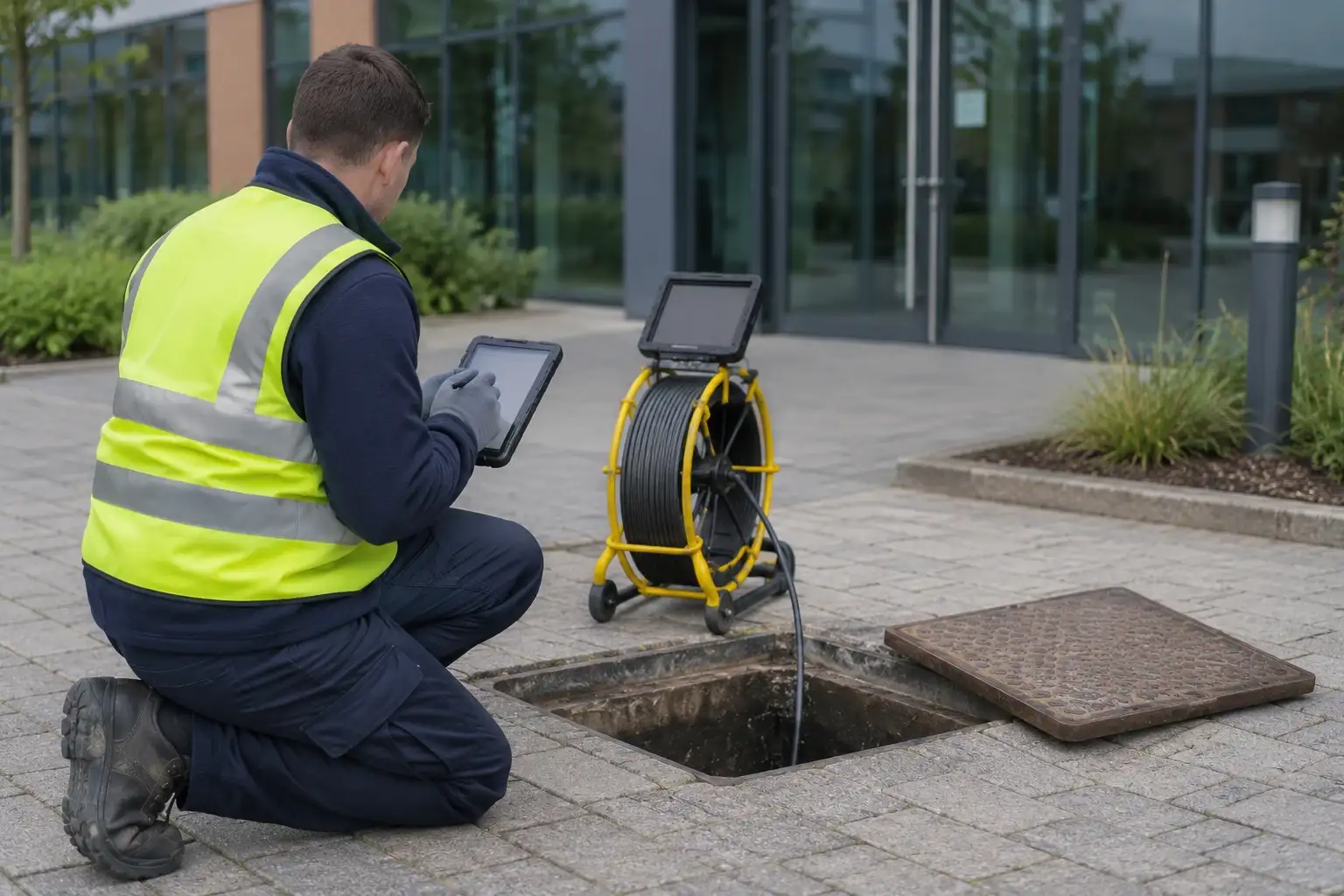
A CCTV drain survey is the practical way to see the condition of underground pipes before you take them on. Done before exchange or lease signing, it gives you evidence to negotiate on price, ask the seller or landlord to repair, agree a rent-free period, or record existing defects so they do not become your liability.
A useful pre-acquisition survey should cover:
- the full private system from building outlets to the point of connection with the public sewer
- a drainage plan showing pipe runs, manholes, flow direction and any misconnections
- graded defects with clear recommendations
- interceptors, grease traps and pumping stations as separate items
Our guide to reading a CCTV drain survey report explains defect grades and what to do with the findings. You can also book a pre-purchase CCTV drain survey.
What does the lease say about repairing the drains?
On a lease, the critical question is what the repairing covenant covers. Under a full repairing and insuring (FRI) lease, the tenant usually takes on repair of the premises, which can include drains within the demise. On multi-let sites, shared drains are often the landlord’s responsibility and recovered through the service charge. Check your lease: the definitions of “the Premises”, “Conduits” and “Common Parts” decide who pays.
The RICS consumer guide to dilapidations says that any records of building condition must be appended to the lease before signing so they form part of the legal contract, and refers to a schedule of condition as one way to record the premises. For drainage, attach the CCTV report and drainage plan to that schedule. Without it, you may struggle to prove that defects found at the end of the term were there when you moved in.
The RICS guide says that, as a general rule, landlords should issue a schedule of dilapidations within 56 days after the end of the lease term, in line with the Dilapidations Protocol.
Are interceptors, grease traps and pump stations assets or liabilities?
Both. They add value when they work and create liability when they do not.
- Oil interceptors (separators): common in car parks, service yards and depots. GPP 3, guidance on oil separators published for Scotland and Northern Ireland (the Environment Agency does not endorse it as regulatory guidance in England), recommends inspection every six months or per the manufacturer’s instructions, emptying as soon as a significant quantity of oil or silt builds up, an alarm when oil reaches 90 per cent of oil storage volume, and a log of inspections and servicing.
- Grease traps: in food premises, fat, oil and grease are controlled because they block sewers. Ask for service records and check that the trap suits the current kitchen. See our commercial kitchen grease management guide.
- Pumping stations: a station serving only your site and within its boundary is generally private. Ask for the maintenance contract, alarm arrangements and age of the pumps.
Missing records are a reason to inspect before you commit.
Do trade effluent consents transfer with the property?
Do not assume so. Under section 118 of the Water Industry Act 1991, if trade effluent is discharged to a public sewer without consent, the occupier of the premises commits an offence. The standard commercial drainage and water search notes that an existing consent depends on the business carried out at the property and will not transfer automatically on a change of ownership. Southern Water says businesses must notify it straight away and apply through their retailer for changes such as a change in the legal identity of the company. Build this into your timetable if you are taking over a process that discharges trade effluent.
What about flood risk and contaminated land?
Flood risk: check the Environment Agency’s long-term flood risk service and Flood Map for Planning. On 25 March 2025 the Flood Map for Planning was updated with new flood zone data, surface water risk, and information on how climate change may affect future flood risk from rivers and the sea. Read it alongside the search answer on sewer flooding.
Contaminated land: drainage can carry contamination from historic uses such as fuel storage or workshops. Under Part 2A of the Environmental Protection Act 1990, liability falls first on those who caused or knowingly permitted contamination, but if none can be found after reasonable inquiry it can fall on the current owner or occupier. If the site’s history suggests risk, ask your solicitor about environmental reports and contractual protection.
Pre-acquisition and pre-lease drainage checklist
- Ask your solicitor to raise the CPSE.1 physical condition, utilities and environmental enquiries, plus specific drainage questions
- Request drainage plans, CCTV reports and maintenance records from the seller or landlord
- Order the commercial drainage and water search (CommercialDW or CON29DW Commercial)
- Check for public sewers within the boundary and any build-over or sewer protection agreements
- Confirm whether drains cross third-party land and that rights of drainage exist
- Commission a CCTV survey of the private system before exchange or lease signing
- List interceptors, grease traps, pumping stations and soakaways, with service history
- Confirm trade effluent consent status and the process for changing it
- Check Environment Agency flood risk and the search answer on sewer flooding
- For leases, confirm who repairs the drains and attach a schedule of condition, including the CCTV findings
- Budget for any repairs, and agree who pays before you commit
For ongoing obligations once you own or occupy the site, see our drainage compliance checklist.
Sources
- CPSE.1 General pre-contract enquiries for all commercial property transactions, Commercial Property Standard Enquiries (Practical Law)
- Southern Water, Drainage and water searches: https://www.southernwater.co.uk/drainage-and-water-searches
- United Utilities Property Searches, CON29DW Commercial sample report: https://propertysearches.unitedutilities.com/media/1249/con29dw-commercial-sample-dec-2023.pdf
- Southern Water, Build over or near a sewer guidance notes: https://www.southernwater.co.uk/media/7889/build-over-a-sewer-guidance-notes.pdf
- Thames Water, Developing over or near sewers: https://www.thameswater.co.uk/developers/larger-scale-developments/sewers-and-wastewater/developing-over-or-near-sewers
- Southern Water, Trade effluent consent: https://www.southernwater.co.uk/commercial/trade-effluent-businesses/trade-effluent-consent/
- Water Industry Act 1991, section 118: https://www.legislation.gov.uk/ukpga/1991/56/part/IV/chapter/III
- Defra, The private sewers transfer regulations (guidance): https://assets.publishing.service.gov.uk/media/5a79a82740f0b642860d9bf7/private-sewers-transfer-guidance110928.pdf
- RICS, Dilapidations in England and Wales (consumer guide): https://www.rics.org/consumer-guides/dilapidations-england-wales
- Pre-Action Protocol for Claims for Damages in relation to the Physical State of Commercial Property at Termination of a Tenancy (the Dilapidations Protocol): https://www.justice.gov.uk/courts/procedure-rules/civil/protocol/pre-action-protocol-for-claims-for-damages-in-relation-to-the-physical-state-of-commercial-property-at-termination-of-a-tenancy-the-dilapidations-protocol
- NetRegs (Scotland and Northern Ireland), GPP 3 Use and design of oil separators in surface water drainage systems: https://www.netregs.org.uk/media/1899/guidance-for-pollution-prevention-3-2022-update-v2.pdf
- GOV.UK, Updates to national flood and coastal erosion risk information: https://www.gov.uk/guidance/updates-to-national-flood-and-coastal-erosion-risk-information
- Environmental Protection Act 1990, section 78F: https://www.legislation.gov.uk/ukpga/1990/43/section/78F
Questions
Is a drainage and water search enough on its own?
No. It reflects water company records and says nothing about the condition of the private drains you would usually be responsible for.
Who should pay for a pre-purchase CCTV survey?
Usually the buyer or incoming tenant commissions it, so the report is independent and addressed to them. Some sellers provide one, but check its date, scope and who it was prepared for.
Can I negotiate on price if the survey finds defects?
Often, yes. A report with graded defects and costed recommendations gives you evidence for a price reduction, a retention, seller repairs before completion, or a rent-free period on a lease.
What if there is no build-over agreement for an extension over a public sewer?
Raise it with your solicitor before exchange. The water company may need to access or repair the sewer, so you will want to understand the risk and any remedy before you commit.
Do I need to tell the water company when I take over a commercial site?
If there is a trade effluent consent, yes: the consent will not transfer automatically, and Southern Water says businesses must notify it straight away of changes such as a change in the legal identity of the company. You will also need to arrange water and sewerage retail supply for the premises.