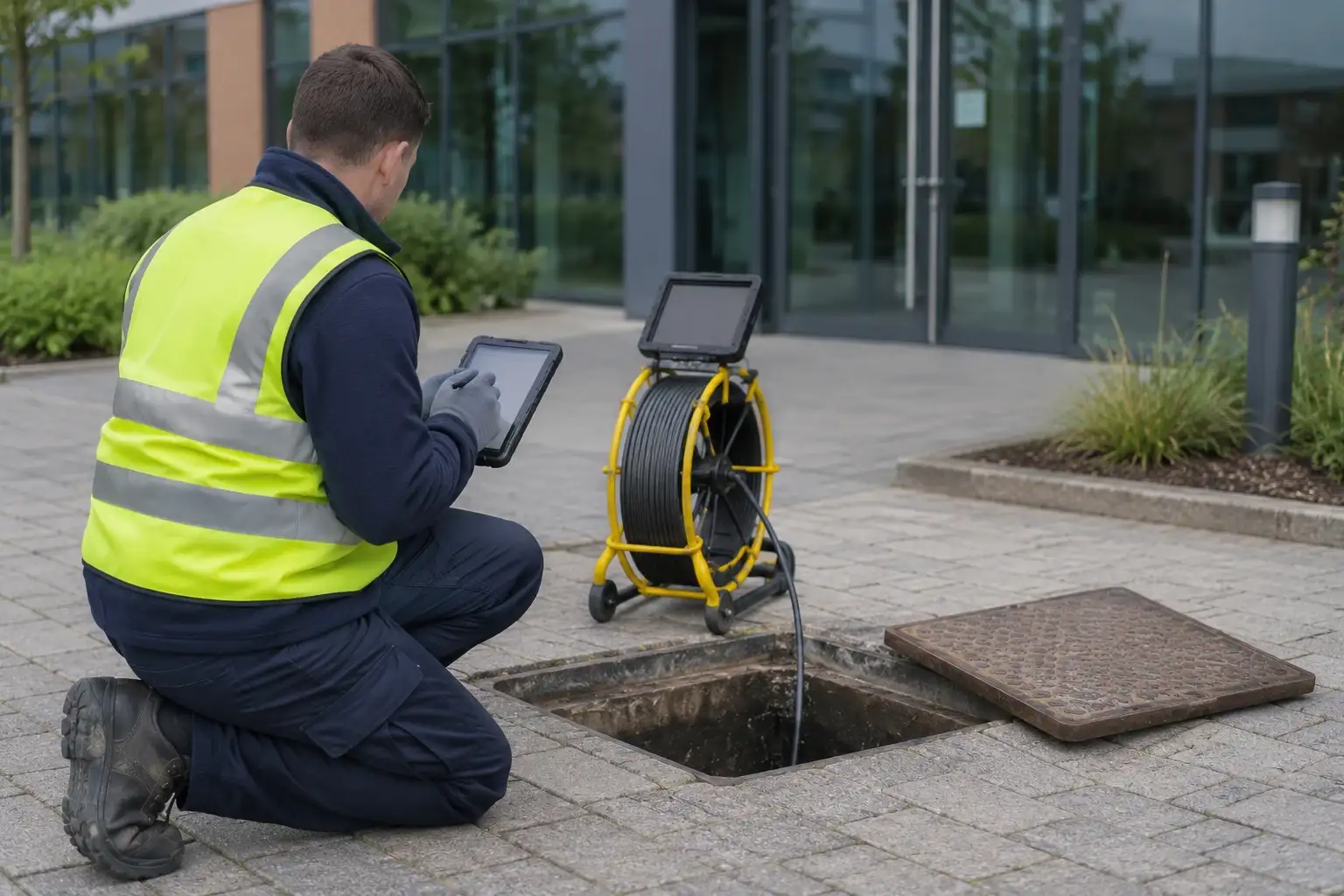
What a commercial drainage maintenance contract should cover

A good commercial drainage maintenance contract lists every drainage asset on your site, sets a visit frequency and task list for each, and defines the report you get after every visit. It fixes response times by priority level, sets out pricing and exclusions, and requires waste paperwork and safety documents. If a quote can’t say what will be done, where and how often, it isn’t manageable.
What does PPM mean for drainage?
Planned preventative maintenance (PPM) means scheduled work on a fixed programme: jetting known problem runs, emptying interceptors and grease traps, and servicing pump stations before they fail. Reactive work is the opposite. You call someone when a drain backs up, a car park floods or a kitchen sink stops draining.
Most commercial sites benefit from both: PPM reduces emergencies and builds a condition record, and reactive cover handles what PPM can’t prevent. A good contract covers both, so you aren’t negotiating rates at 2am. For how often individual assets typically need attention, see our guide on how often to service commercial drains.
The contract checklist
1. Asset register and baseline CCTV survey
Everything else in the contract depends on knowing what you have. The contract should include, or be built from:
- an asset register listing each manhole, gully, channel drain, interceptor, grease trap, pump station and soakaway, with a reference number and location
- a site drainage plan, marked up and updated as assets are found or changed
- a baseline CCTV survey of the main runs, so later reports can be compared against a known starting condition
If no survey exists, expect the contract to start with one. Our CCTV drain survey report guide explains what a usable report should contain.
2. Visit frequency per asset
Avoid a single “quarterly visit” for the whole site. Set a frequency for each asset by risk and use, in writing and by asset reference, and review it once the first year’s data is in.
3. Tasks for each asset type
Spell out what happens at each visit, not just “service drains”. Typical tasks to list include:
| Asset | Tasks to specify |
|---|---|
| Foul and surface water runs | High-pressure jetting of named runs, chamber inspection, benching and cover checks |
| Gullies and channel drains | Emptying silt traps, clearing gratings, jetting connections |
| Oil interceptors (separators) | Measuring oil and silt levels, emptying when needed, checking alarms where fitted |
| Grease traps and grease removal units | Emptying and cleaning, checking baffles and lids, recording fill levels |
| Pump stations | Checking pumps, floats and alarms, cleaning the wet well, testing changeover |
| Soakaways | Inspecting for silt build-up and checking they drain down |
Southern Water advises food businesses that equipment such as grease separators should be “cleaned and maintained on a regular basis”. It also points out that businesses must not let their waste block or damage the sewer, under section 111 of the Water Industry Act 1991. See our commercial kitchen grease management guide for more.
4. Reporting after every visit
Ask for a written report after each visit, delivered within an agreed number of working days. It should include:
- the date, the operatives’ names and the assets visited, by reference
- the work done and anything that couldn’t be done, with the reason
- before and after photos
- defects found, ideally coded and graded so you can compare them over time, with a recommended action and priority
- any waste removed, cross-referenced to the waste paperwork
5. Emergency response times and priority levels
“We’ll get there as soon as possible” is not a response time. The contract should define priority levels and attach a time to each. A common structure looks like this:
| Priority | Typical definition | What to agree |
|---|---|---|
| P1 Emergency | Flooding, sewage escape, risk to health or safety, or loss of a critical service (such as a kitchen or toilets that can’t be used) | Attendance time in hours, 24/7 |
| P2 Urgent | Slow drainage or a partial blockage likely to become an emergency | Attendance time in hours or by the next working day |
| P3 Routine | Defects from reports and non-urgent repairs | Quote within set days, then scheduled work |
The times are yours to negotiate. Also agree what “response” means: a call back, an engineer on site, or the problem made safe.
6. Out-of-hours terms
Set out who can authorise out-of-hours call-outs, how they are charged (evening, weekend and bank holiday rates, minimum charges, travel) and whether any are included in the fixed fee.
7. Pricing structure
There are two common models, and many contracts combine them:
- Fixed annual fee. This covers the scheduled PPM programme. It makes budgeting easy, but check exactly which visits and tasks it includes.
- Schedule of rates. This is a priced list for reactive and extra work, such as hourly rates, jetting unit day rates, CCTV per metre or per day, and tanker disposal per load. It makes invoices checkable.
For typical annual costs, see our commercial drainage costs guide.
8. Exclusions
Find the exclusions before the first invoice does. Common ones:
- repairs, excavation and relining (usually quoted separately)
- disposal costs for waste beyond a set volume
- traffic management, permits and road closures
- confined space entry
- damage caused by misuse, such as wipes or fat in drains
- assets not on the register
9. Waste disposal and documentation
As the business whose waste is removed, you have a legal duty of care for it (section 34 of the Environmental Protection Act 1990). GOV.UK guidance says:
- Waste transfer notes: both you and the business taking the waste must fill in and sign the relevant sections, and keep a copy for 2 years. A “season ticket” can cover repeat transfers of non-hazardous waste for up to a year if the holder, carrier and type of waste stay the same. It must be supported by a schedule of each collection, kept for 2 years after the last transfer.
- Hazardous waste: you must use a consignment note to move hazardous waste. GOV.UK lists oils “(except edible ones)” among typical hazardous wastes, which is relevant to oil interceptor contents. Producers and holders must classify the waste, check the carrier is registered, complete their parts of the note, and keep records for 3 years at the premises that produced or stored it.
Since 1 October 2026, sites in England and Wales that are permitted to receive waste must report it through the government’s digital waste tracking service. GOV.UK says the paper system continues alongside it “until further notice”, so these notes are still needed. The contract should require the correct paperwork for every removal and confirm the contractor’s waste carrier registration.
10. Health and safety documents
Ask for these before work starts, and make keeping them current a contract condition:
- RAMS (risk assessments and method statements) for each type of task, specific to your site
- Insurance certificates: public liability and employer’s liability, with limits that meet your requirements
- Confined space competence: the Confined Spaces Regulations 1997 define a confined space as including any “chamber, tank, vat, silo, pit, trench, pipe, sewer, flue, well” or similar space where, because it is enclosed, there is a reasonably foreseeable specified risk (such as fire, gas or drowning). The regulations say no one at work may enter a confined space to do work unless it isn’t reasonably practicable to do it without entering. If entry is needed, it must follow a safe system of work, with rescue arrangements prepared first. The HSE says it’s “not enough to rely on the emergency services”. Deep chambers, wet wells and sewers can fall within this. Ask how the contractor avoids entry, and ask for training records and the rescue plan if entry is needed.
11. Accreditations to ask about
These schemes help you check a contractor before you appoint them. Ask for current certificates and check them with the scheme:
- CHAS: a health and safety assessment scheme. Its assessors review a contractor’s policies, training, insurance and COSHH procedures. CHAS describes itself as a co-founder of SSIP (Safety Schemes in Procurement), and its Elite tier covers the Common Assessment Standard.
- SafeContractor (Alcumus): a contractor accreditation scheme covering health and safety, sustainability and ethical behaviour. It describes itself as a founding member of SSIP.
- Constructionline: a supplier pre-qualification platform whose Gold membership aligns with the industry’s Common Assessment Standard.
- Water Jetting Association (WJA): the WJA runs water jetting training, with its main course programme accredited by City & Guilds and a dedicated drain and sewer module. Trained operatives receive a digital jetting card that is valid for three years. Ask whether the operatives on your site hold current cards.
12. KPIs and service reviews
Agree a few measures, such as planned visits completed on schedule, response times met, reports delivered on time and repeat call-outs to the same asset. Review them quarterly or six-monthly alongside defects and next year’s priorities.
13. Term, notice and renewal
Check the initial term, notice period, any automatic renewal and how prices change at renewal. Make sure you can exit for persistent poor performance against the KPIs. Confirm that the asset register, drawings, reports and survey footage belong to you and will be handed over if the contract ends.
14. Multi-site portfolios
For a portfolio, ask for one register and reporting format across all sites, site-by-site pricing, a single call-out route and consolidated invoicing if needed. Confirm response times apply at every site, not just those near the contractor’s depot. Our guide to who is responsible for commercial drains can help you split responsibilities with tenants or landlords. Check each lease.
Questions to ask before you sign
- Can you show me a sample visit report and a sample CCTV report?
- Which assets and tasks does the fixed fee cover, by reference?
- What exactly counts as a P1 emergency, and what is the attendance time?
- What is excluded, and what are the rates for excluded work?
- Which carrier removes the waste, and what paperwork will I get?
- Are your operatives WJA-trained? Who is trained for confined space work?
- Who owns the data, footage and drawings if we part ways?
Red flags
- A single price for the whole site with no asset list or task breakdown
- Response times described as “ASAP” or “same day where possible”
- No sample reports, or reports with no photos
- Vague answers on waste disposal, or no transfer notes offered
- Generic RAMS that don’t mention your site
- Long automatic renewals with no performance exit
Download our free drainage compliance checklist to track the records your site should hold.
Sources
- GOV.UK, Dispose of business or commercial waste: Waste transfer notes: https://www.gov.uk/dispose-business-commercial-waste/waste-transfer-notes
- legislation.gov.uk, Environmental Protection Act 1990, section 34 (duty of care): https://www.legislation.gov.uk/ukpga/1990/43/section/34
- GOV.UK, Hazardous waste: https://www.gov.uk/dispose-hazardous-waste
- GOV.UK, Hazardous waste: Producers and holders: https://www.gov.uk/dispose-hazardous-waste/producers-and-holders
- GOV.UK, Hazardous waste: Consignment notes: https://www.gov.uk/dispose-hazardous-waste/consignment-notes
- GOV.UK, Digital waste tracking: check if you need to report the waste you receive: https://www.gov.uk/guidance/digital-waste-tracking-check-if-you-need-to-report-the-waste-you-receive
- legislation.gov.uk, The Confined Spaces Regulations 1997: https://www.legislation.gov.uk/uksi/1997/1713
- HSE, Introduction to working in confined spaces: https://www.hse.gov.uk/confinedspace/introduction.htm
- Southern Water, Managing FOG in your food business: https://www.southernwater.co.uk/help-and-support/managing-fat-oil-and-grease-fog-food-businesses/
- Water Jetting Association, Training: https://waterjetting.org.uk/training/
- CHAS, Contractor health and safety assessment: https://www.chas.co.uk/contractors/health-safety-assessment/
- SafeContractor, About us: https://www.safecontractor.com/en-gb/about-us/
- Constructionline, Common Assessment Standard: https://www.constructionline.co.uk/products-services/common-assessment-standard/
- Constructionline, Why is Constructionline’s Gold membership the most popular?: https://www.constructionline.co.uk/insights/blog/why-is-constructionlines-gold-membership-the-most-popular/
Questions
Is a drainage maintenance contract a legal requirement?
Not usually in itself. But you may have duties that a contract helps you meet, such as not letting your waste block the public sewer, or keeping waste records. Your lease or insurer may also require planned maintenance.
Who keeps the waste transfer notes?
Both parties. GOV.UK guidance says you and the business taking the waste must each keep a copy for 2 years. For hazardous waste, producers and holders must keep records for 3 years.
Are fixed-fee contracts always better value?
Not always. A fixed fee suits predictable PPM work. A schedule of rates is fairer for reactive and extra work, which is hard to predict.
How often should the contract be reviewed?
As a rule of thumb, hold service reviews at least every six months. Do a fuller review of frequencies and scope after the first year, once you have real data.
Do accreditations guarantee good work?
No. They show a contractor's systems or training have been assessed; still check references, sample reports and site-specific RAMS.